671

Author
Meat.Milk
Share on


Published on
2026 September 23
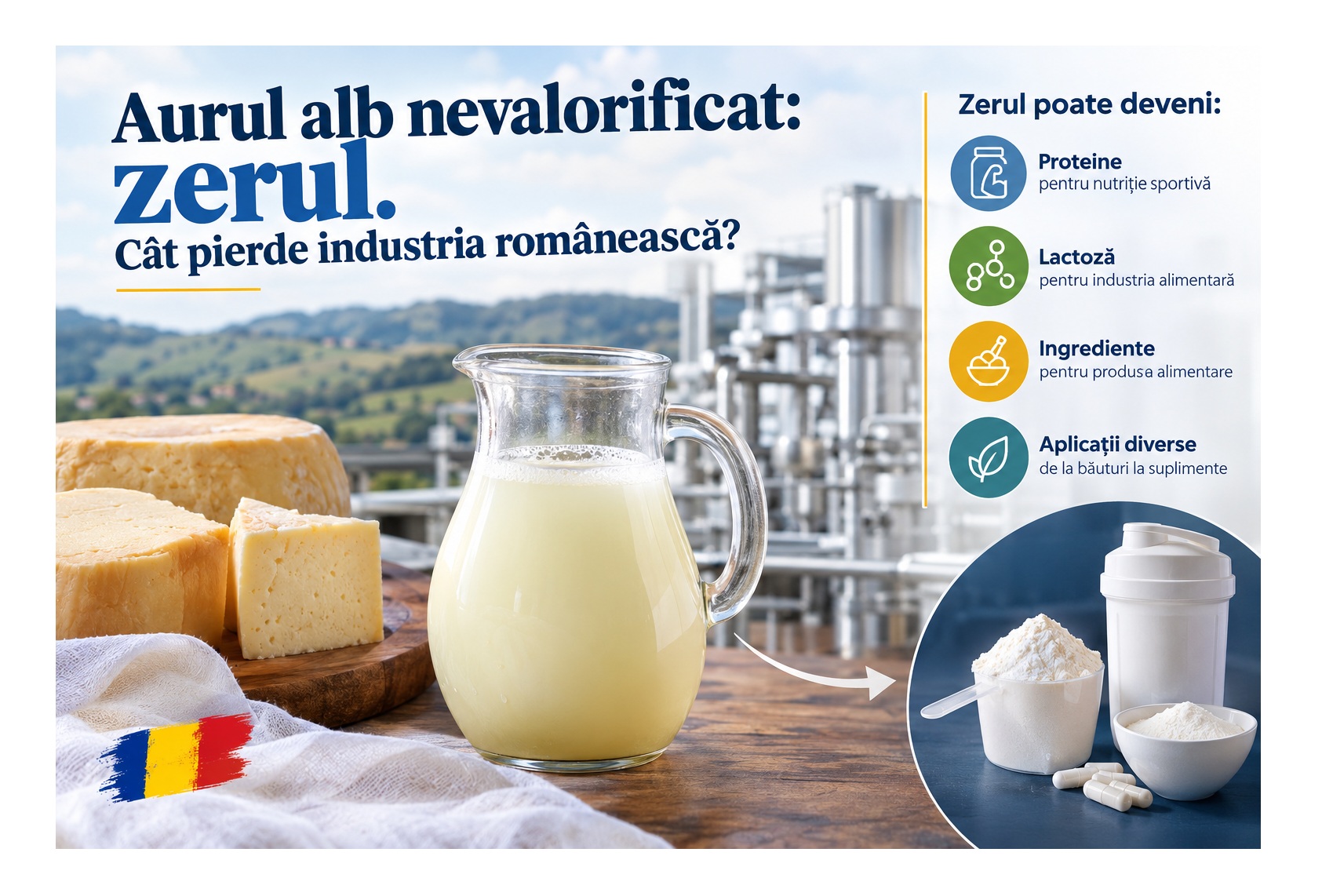
Romania produces milk, produces cheese, and produces whey. But the maximum economic value is not always found in the product that reaches the shelf. An important part of it lies in what remains after processing.
In the dairy industry, whey — or lactoserum — is much more than the liquid that remains after cheese production. The European Commission describes it as a by-product with high nutritional value, containing lactose, minerals, vitamins, and high-quality proteins. Depending on the technology used, these components can be recovered and transformed into ingredients for the food industry, sports nutrition, and other applications.
The order of magnitude explains what is at stake. According to the European EU CAP Network, producing one kilogram of cheese can generate up to 9 liters of whey, depending on the type of cheese. In other words, a plant’s secondary stream can represent a considerable volume of raw material.
Eurostat data for Romania show that, in 2022, 102,790 tonnes of cheese and 105,390 tonnes of whey obtained in the dairy industry were recorded. Eurostat also shows that, of this quantity of whey, 15,840 tonnes were used in liquid form, while data concerning its use in concentrated or powdered form are marked as confidential.
This is where the economic question arises: how much is what the industry fails to transform into value-added ingredients actually worth?
The correct answer is that official statistics do not provide a figure for Romania’s “loss” in euros. It would be incorrect to simply multiply the quantity of whey by the price of a protein concentrate. The costs of collection, cooling, filtration, ultrafiltration, concentration, drying, and standardization can radically change the final economic value.
But the direction is clear. Whey can be turned into protein concentrate or isolate, lactose, functional ingredients, and raw material for products intended for sports nutrition. EFSA explicitly treats whey as an ingredient for a wide range of food products, while the European Commission also documents the use of lactose obtained from whey and protein concentrates.
Romania’s problem, therefore, is not a lack of raw material. The problem is how far the industry manages to move up the value chain.
One tonne of liquid whey is not equivalent to one tonne of protein powder. But neither is it merely a residue. Between the two lie technology, energy, capital, research, logistics, and, above all, the industrial capacity to transform a by-product into a commercial ingredient.
In Europe, whey is already an industry in its own right. In 2024, EU dairy plants produced approximately 52.9 million tonnes of whey, expressed in liquid equivalent. Germany was the European leader, with approximately 14.4 million tonnes, followed by the Netherlands and Poland.
For Romania, the strategic question is not whether we have whey.
The question is why we do not transform enough of it into added value, know-how, and industrial margin here, in Romania.
And if the answer is technology, investment, or economies of scale, then that is precisely where the dairy industry’s next business opportunity should be sought.
Did you learn something new from this article?
Read also: