168

Author
Meat.Milk
Share on


Published on
2026 October 26
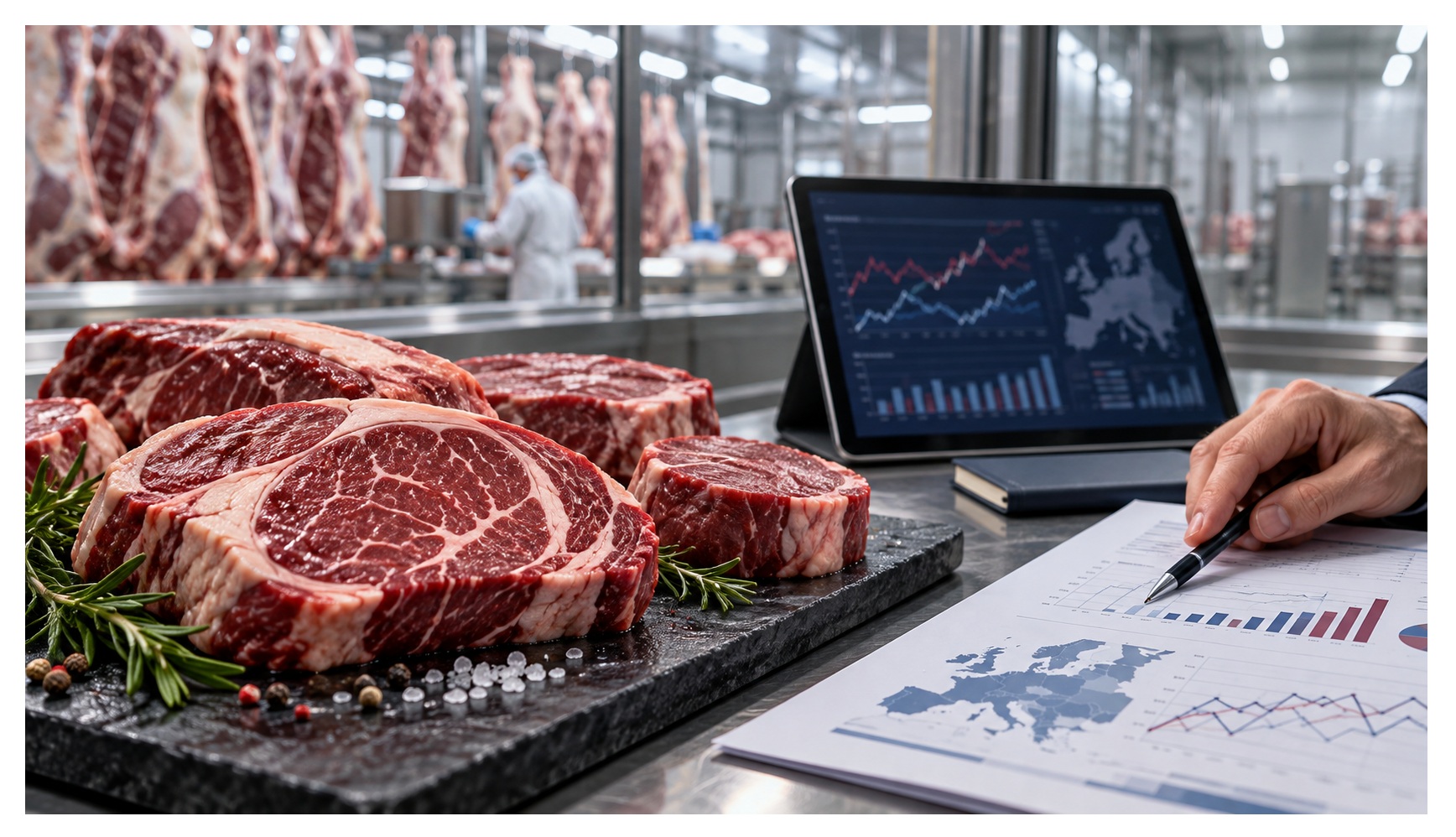
A weekly increase does not automatically mean the market is recovering. The latest European data on bovine carcasses show different trends across categories, and Romania is close to the EU average for young bulls in the A‑R3 class.
The European Commission’s Meat Market Observatory update of 22 October 2026 presents prices for the week of 12–18 October. For operators in the sector, the figures provide negotiating benchmarks, but they must be read according to the animal’s category and the carcass classification.
Young bulls: weekly gain, annual decline
For young bulls aged 12–24 months, category A, class R3, the average European price reached 649.24 euro/100 kg of carcass, up by 3.51 euro, or 0.54%, from the previous week.
The year-on-year comparison, however, changes the picture: the same quotation is 9.9% below the level of the corresponding week in 2025. The data therefore point to a weekly strengthening of the price, without confirming that the gap compared with last year has been recovered.
For Romania, the price reported for the same category and class was 645.83 euro/100 kg of carcass. The difference from the European average is approximately 3.41 euro/100 kg, or 0.53%. This is a relevant convergence for this segment, but it cannot be automatically extended to the entire Romanian beef market.
The market is moving differently across categories
For cows in category D, class O3, the EU average was 540.66 euro/100 kg of carcass, 0.27% lower than in the previous week and 16.2% below the level of a year ago. Romania reported 519.48 euro/100 kg for the same class.
By contrast, for heifers in category E, class R3, the European average reached 685.56 euro/100 kg, up 0.12% week on week but down 6% year on year.
These differences matter in purchasing and in the assessment of batches. A single average does not adequately describe a market in which the animal’s category and the characteristics of the carcass influence the reported price.
What the figures mean for buyers and consumers
The values are expressed in euro per 100 kg of carcass. They are not prices for live animals, nor shelf prices. Converting them directly into a price for boneless meat would ignore the cutting yield, the structure of the cuts and downstream costs.
For farmers, slaughterhouses and processors, a useful comparison starts from the same category, the same class and the same period. For consumers, this approach explains why a change in the carcass quotation is not passed on identically and immediately to every individual cut sold.
The week’s data show a market with moderate short-term movements and annual differences that are still significant. For Romania, the closeness to the EU average in A‑R3 is a concrete benchmark to follow in the coming updates.
Did you learn something new from this article?
Read also: