542

Author
Meat.Milk
Share on


Published on
2026 October 05
Weight at delivery is an important benchmark for pig producers. For processors, however, assessment continues after slaughter: what matters is the quantity of marketable meat, its distribution across the cuts and its suitability for the products being manufactured. A heavier animal may provide more raw material without every additional kilogram delivering the same economic value.
The first distinction is between live weight and carcass weight. The latter refers to the animal’s body after bleeding and evisceration, presented in accordance with classification rules. Carcass weight does not, in itself, indicate an equivalent quantity of lean meat. The European classification system reflects this distinction: under Regulation (EU) No 1308/2013, class S corresponds to an estimated lean meat content of at least 60%, while class E corresponds to at least 55% but less than 60%. These percentages are expressed relative to carcass weight.
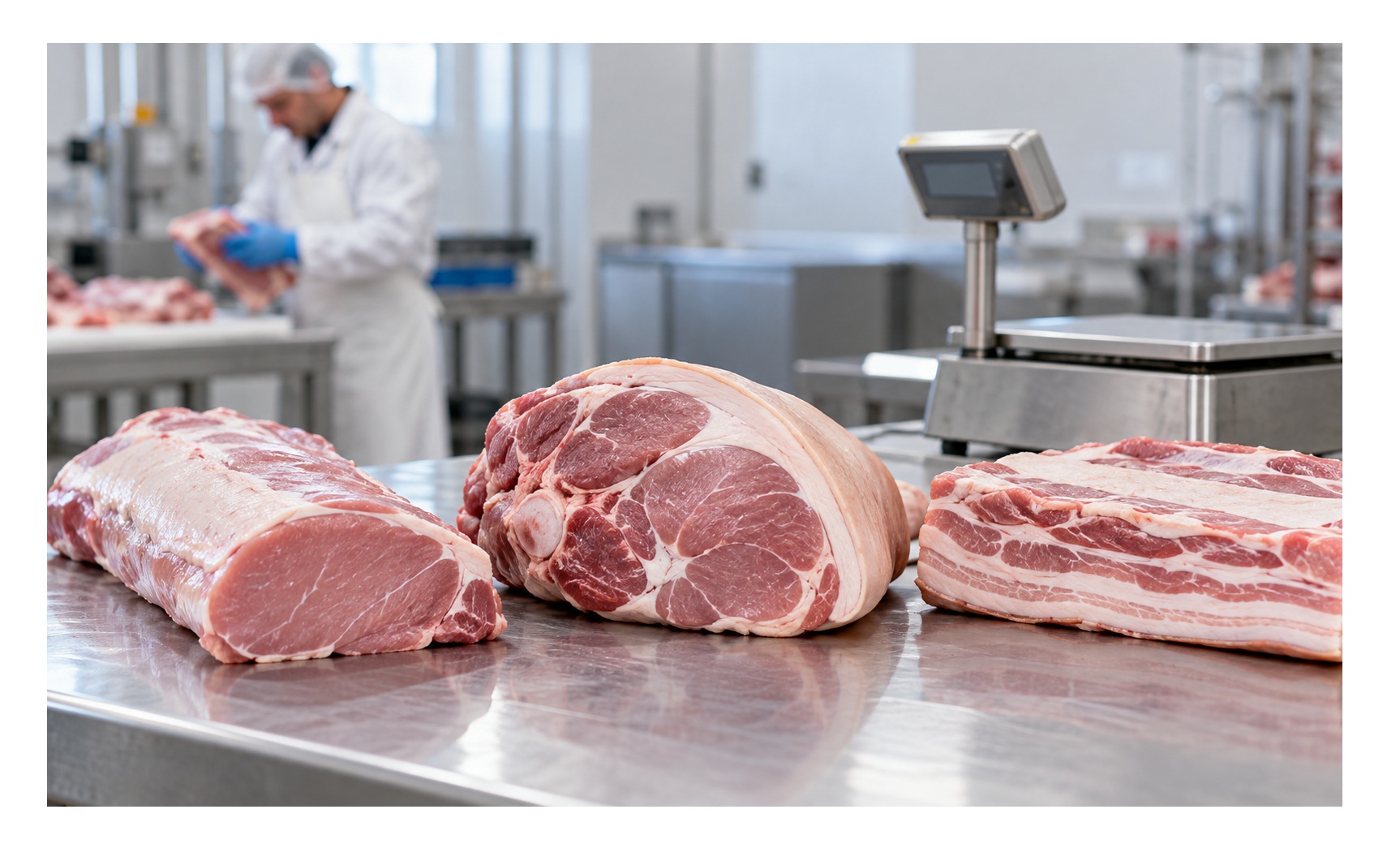
At cutting, the assessment becomes more precise. The loin, leg, shoulder and belly enter different commercial channels. Their value depends on the quantities obtained, the trimming specifications and the form in which they are sold. An analysis conducted as part of the US Genetics of Lean Efficiency project, presented by Pork Information Gateway, illustrates this relationship: at the same weight, pigs with larger loins and less fat could be worth more to processors selling boneless cuts. The outcome depended on the cutting strategy and the prices of the individual components.
Weight is no substitute for quality assessment
A study published in the Journal of Animal Science in 2017 examined 7,684 pigs with carcass weights ranging from 53.2 to 129.6 kilograms. Weight explained no more than 5.60% of the variation in the quality indicators investigated for the loin and leg. Within the range studied, increasing weight did not compromise loin, leg or belly quality, but neither did it allow all their characteristics to be reliably predicted.
The intended processing use also changes the selection criteria. In an experiment involving 200 gilts, slaughtering at a live weight of 122 kilograms rather than 106 kilograms improved carcass yield but reduced the yield of trimmed primal cuts. The authors highlighted the suitability of heavier pigs for the dry-cured meat industry, where a certain amount of fat is required.
For the relationship between farmers and processors, these findings support setting shared targets before delivery: weight range, composition and the intended use of the cuts. The timing of slaughter can thus be aligned with the buyer’s requirements, while farm performance can also be assessed in terms of the raw material it provides at cutting.
(Photo: AI GENERATED)
Did you learn something new from this article?
Read also: