780

Author
Meat.Milk
Share on


Published on
2026 April 17
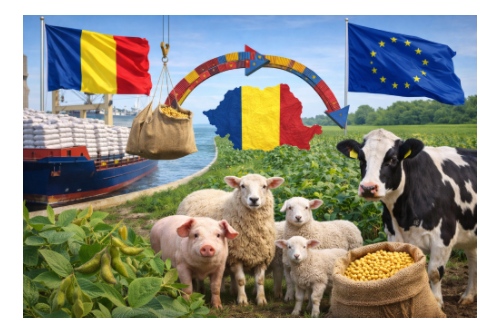
The European Union’s dependence on imported plant protein for animal feed remains one of the most persistent vulnerabilities of the European agri-food system. According to data published by the European Commission and Eurostat, approximately 65–70% of the plant protein required for feed is covered through imports, primarily in the form of soybean meal sourced from Brazil, Argentina and the United States. This dependence is the result of a structural imbalance between agricultural production focused predominantly on cereals and the nutritional requirements of the livestock sector.
In Romania, the situation closely reflects this European model. Data provided by the National Institute of Statistics and the Ministry of Agriculture and Rural Development indicate significant production of maize and wheat, but a limited share of protein crops. Although the area cultivated with soybeans has increased in recent years, supported in part by coupled support under the Common Agricultural Policy, it remains insufficient to meet domestic demand. As a result, the livestock sector — particularly pork and poultry production — depends directly on imports for feed formulation.
The economic impact of this dependence is significant. Feed costs account for between 60% and 70% of total production costs in livestock farms, according to analyses by the Food and Agriculture Organization of the United Nations. Volatility in international soybean prices, driven by climatic, geopolitical or logistical factors, is rapidly transmitted throughout the agri-food chain. Recent crises, including trade disruptions generated by the conflict in Ukraine, have highlighted the direct exposure of European farmers to these fluctuations.
From a strategic perspective, this dependence limits the competitiveness of the European agri-food sector. While exporting countries benefit from lower costs and vertical integration, EU producers operate in a context of higher costs and uncertainty. In Romania, this translates into an economic paradox: consistent exports of agricultural raw materials alongside imports of essential inputs for animal production.
At European level, the policy response includes initiatives to develop protein crops, supported through the Common Agricultural Policy and dedicated strategies. The European Commission has promoted crop rotation diversification and incentives for the production of soybeans, protein peas and other legumes. However, progress remains gradual, and the gap relative to actual demand persists.
For Romania, the opportunity is clear: expanding the area cultivated with protein crops, developing domestic processing capacities and integrating crop production with livestock farming. In the absence of such measures, dependence on imports will continue to influence costs, competitiveness and the stability of the agri-food sector.
(Photo: Freepik)
Did you learn something new from this article?
Read also: