249

Author
Meat.Milk
Share on


Published on
2026 November 06
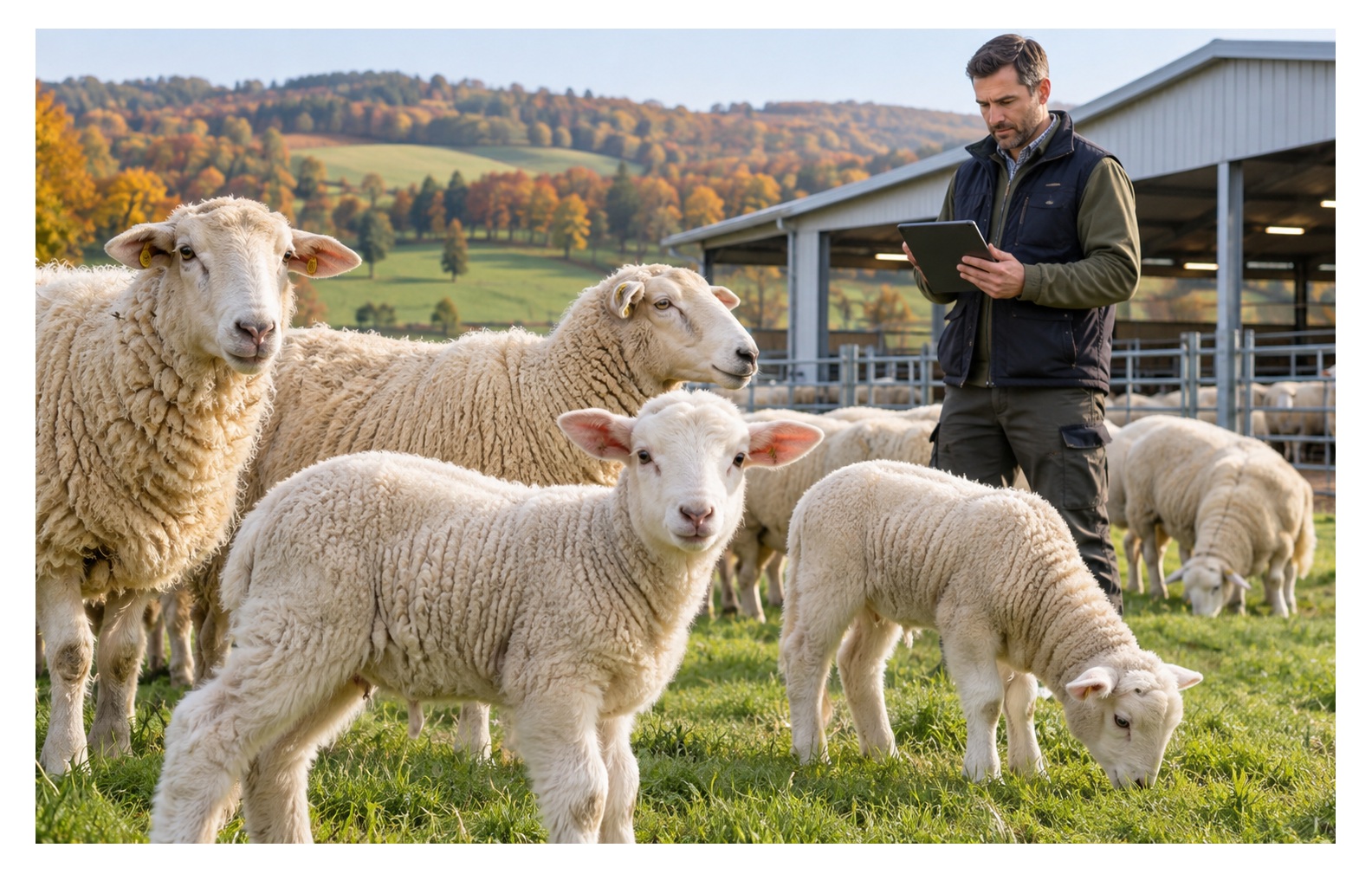
Lamb prices are rising in the European Union, while sheep slaughter volumes remain below last year’s level. The European Commission report, updated on 4 November 2026, presents a market with significant differences between categories, countries and trading destinations. For Romania, interpreting these indicators requires a careful distinction between European prices and national production figures.
Two categories, the same direction in prices
In week 44, the European price for heavy lambs, with a carcass weight exceeding 13 kg, reached EUR 958.2/100 kg carcass weight. This was 1.8% above the previous week, 4.0% above the monthly benchmark and 9.7% above the annual benchmark.
For light lambs, the price reached EUR 1,089.2/100 kg carcass weight, up 1.4% week on week, 3.1% against the monthly benchmark and 12.3% year on year.
Prices are increasing in both categories, but the annual rise is more pronounced for light lambs. These are European prices expressed per unit of carcass weight, rather than prices for live animals or meat sold at retail.
Slaughter volumes are not following the same trend
Data on sheep slaughterings in abattoirs, accumulated up to July 2026 and expressed in meat volume, show a decline of 0.9% across the EU compared with the corresponding period in 2025.
National trends differ. Spain recorded 54,000 tonnes, down 6%; France reached 42,300 tonnes, up 3%; and Ireland reported 29,700 tonnes, down 5%.
For Romania, the report indicates 9,000 tonnes, 2% below the comparable period in 2025.
Rising prices and falling slaughter volumes therefore feature in the same European picture. However, the document does not establish that either development, on its own, explains the other.
Romania: a substantial share of the number of animals slaughtered
Viewed through a different indicator, Romania’s position is significant. For the whole of 2025, the report records 5.871 million sheep slaughtered, representing 19% of the European total presented. Romania ranks behind Spain, which recorded 7.521 million head and a share of 25%.
This comparison concerns the number of animals, rather than meat tonnage. It should not be conflated with the data on slaughter volumes accumulated up to July 2026.
What the report reveals beyond prices
For the Romanian sector, the picture combines a substantial share of the number of sheep slaughtered with a decline in the volume of meat reported in the first seven months of 2026.
Rising European prices provide commercial context, but the report does not present a separate price for Romania here. The distinction between animal numbers, carcass volumes and prices by category remains essential: each indicator describes a different part of the market.
Did you learn something new from this article?
Read also: