666

Author
Meat.Milk
Share on


Published on
2026 September 24
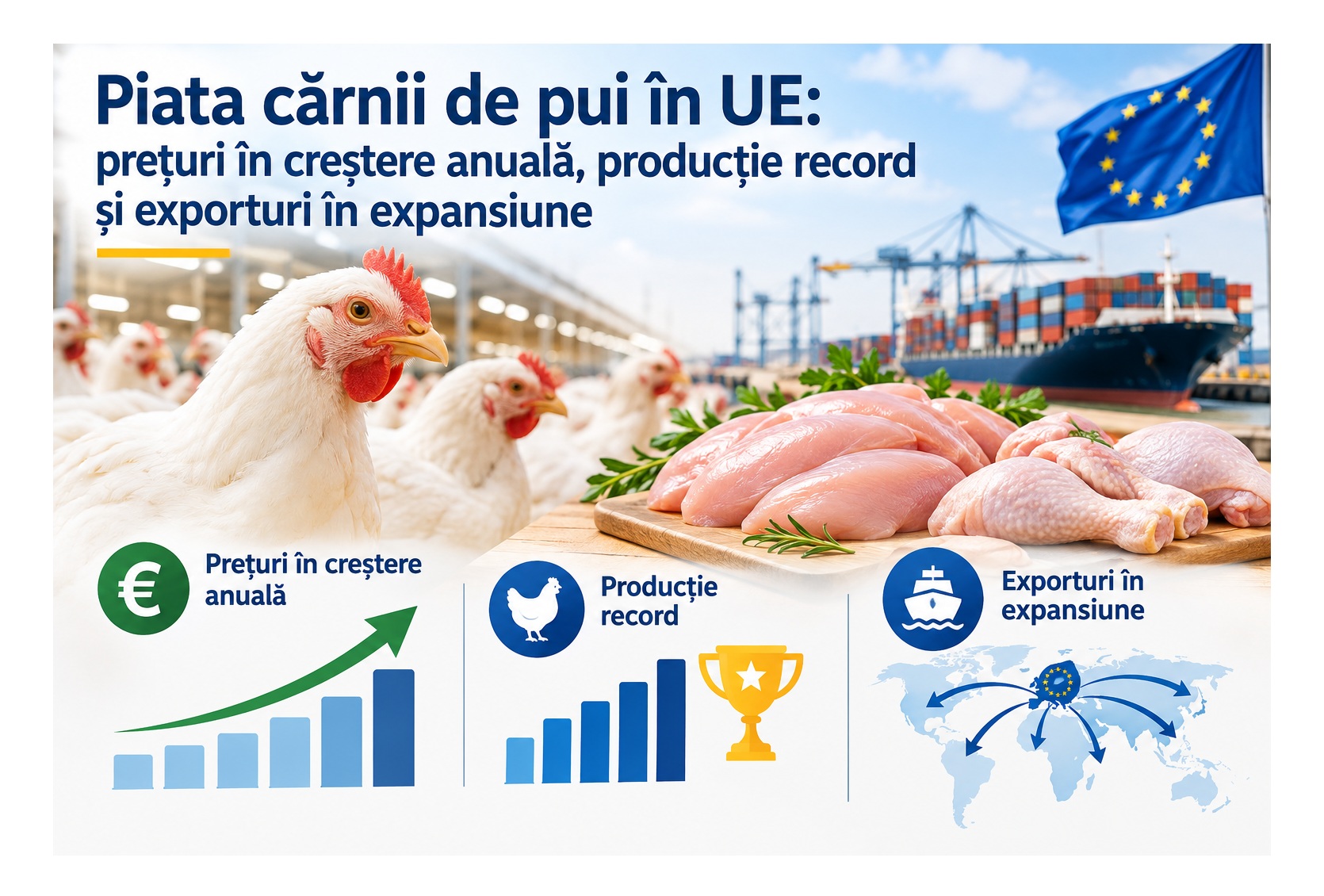
The latest dashboard from the European Commission’s Directorate-General for Agriculture and Rural Development (DG AGRI), updated on September 23, 2026 (week 38), confirms a solid poultry meat market, with sustained prices and expanding foreign trade, against the backdrop of European production reaching a record level.
Broiler prices under seasonal pressure, but above the multi-year average
The average weekly broiler price at EU level was €292.42/100 kg carcass weight in week 38. The comparative evolution shows a decrease of 0.9% compared with the previous week and of 3.7% compared with the same period last year, but an increase of 2.7% compared with the previous month. The weekly price trend chart shows that, after a peak reached during the May-July period (above €305/100 kg), the 2026 price followed a trajectory clearly above the 2021-2025 average, although slightly below the level recorded in 2025.
By product segment, chicken breast prices (breast fillet) remain the market’s value driver, standing at around €620/100 kg, compared with approximately €285/100 kg for Class A chicken and around €255/100 kg for legs — a gap that confirms the premiumization trend for breast cuts at European level.
In international comparison, European broiler prices continue to stand significantly above those of major competitors: €292.42/100 kg in the EU, compared with €223.67/100 kg in the United States and just €134.06/100 kg in Brazil — a differential that reflects both the European cost structure and stricter animal welfare and food safety standards.
Record production, with Poland as the undisputed leader
In 2025, total poultry meat production in the EU reached 14,322 thousand tonnes, up 2.1% from the previous year. Poland remains the clear leader, with 2,892 thousand tonnes (21% of the total), followed by Spain (1,803 thousand tonnes, 13%), France (1,722 thousand tonnes, 12%), Germany (1,570 thousand tonnes, 11%), and Italy (1,391 thousand tonnes, 10%). Together with the Netherlands (841 thousand tonnes, 6%), these six Member States account for 72% of European production. By category, broiler meat accounts for 87.1% of total production, followed by turkey (9.0%) and duck (2.0%).
Eurostat data on production trends in 2026/2025 (through June) show a European average of +5.5%, with notable differences between Member States: Hungary (+19.2%), Romania (+16.0%), and Poland (+12.1%) recorded the highest increases, while Sweden (-6.5%), Germany (-4.1%), and Greece (-2.4%) are among the few countries with declining production. Romania’s position as second in Europe in terms of production growth rate is worth noting, representing a relevant signal for the domestic industry.
Broiler chick placements in 2026 confirm this expansionary trend: monthly figures (above 600,000 thousand head in March and July 2026) are, in most months, above the levels recorded in 2024 and 2025.
Production costs stable, but under pressure
The ratio between the farm-gate price of broilers and the costs directly attributable to fattening shows a relatively constant margin in recent months: the farm-gate price is hovering around €120-125/100 kg, while total costs (feed, energy, and other costs) stand at around €70-75/100 kg, with feed remaining the dominant component.
Foreign trade: moderate export growth, accelerating imports from Chile and Ghana
Between January and May 2026, EU poultry meat exports totaled 867,981 tonnes, up 1.6% compared with the same period in 2025, with the United Kingdom remaining the main destination (302,539 tonnes). The most dynamic increases were recorded for Congo (+18.0%) and the Philippines (+45.4%).
On the import side, total volume reached 1,185,979 tonnes (+1.0%), with Brazil as the main supplier (431,323 tonnes, +17.3%). The most spectacular development was recorded in imports from Chile, which increased by 286.1% in volume and by 289.9% in value, although from a low base.
At global level, Brazil and the United States dominate worldwide exports of poultry meat products, with the EU ranking third, at approximately 800 thousand tonnes exported between January and May 2026, while China and Hong Kong have increased their imports, almost matching Japan and the United Kingdom.
Currency context
The evolution of the euro against the US dollar and the Brazilian real directly affects export competitiveness: the euro appreciated against the US dollar (above USD 1.15/EUR in 2026, compared with lows below 1.05 in 2025), while against the Brazilian real it remained relatively stable, at around BRL 6.0/EUR.
Did you learn something new from this article?
Read also: