2044

Author
Meat.Milk
Share on


Published on
2026 March 02
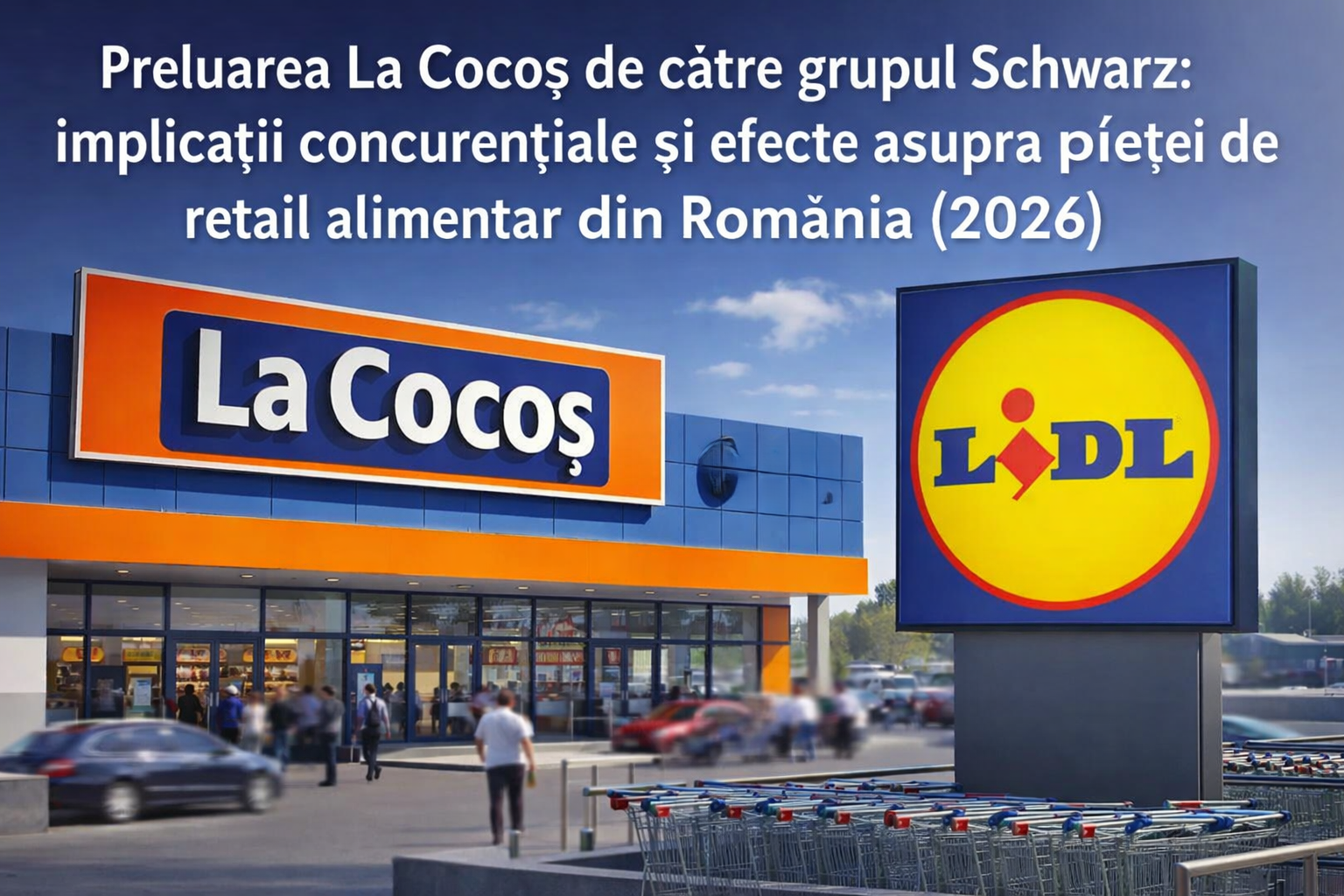
The transaction through which the Romanian retail network “La Cocoș” is set to be acquired by the German Schwarz Group, owner of Lidl and Kaufland, has entered the review of the Competition Council, in accordance with Competition Law no. 21/1996 and the regulations governing merger control. The operation has systemic relevance for the food retail market, given that Lidl and Kaufland are already among the leading operators by turnover in Romania, according to data published by the Ministry of Finance and sectoral analyses of the Competition Council.
The authority’s assessment focused on defining the relevant market – modern retail trade of fast-moving consumer goods, both food and non-food – and on analyzing effects at the local level. In such cases, the Competition Council examines combined market shares in areas of geographic overlap, the distance between stores, and the level of concentration, using indicators such as the Herfindahl-Hirschman Index. In Romania, the food retail market is characterized by high penetration of modern retail, exceeding 70% of total FMCG sales, according to public sector studies.
In situations where an economic concentration may lead to the strengthening of a dominant position at the local level, the authority may impose structural or behavioral commitments. These may include the divestiture of assets in certain cities, maintaining non-discriminatory conditions for suppliers, or limiting restrictive commercial practices. The objective of such intervention is to prevent a reduction in competitive pressure and to protect the interests of consumers and suppliers.
For the meat and dairy industry, the transaction carries a strategic dimension. The consolidation of the bargaining power of a group already present through two major retail formats may influence contract structures, payment terms, and listing policies. According to the Competition Council’s annual reports on commercial relations in the agri-food sector, bargaining imbalances between retail and processors represent a recurring theme in market analysis.
In the medium term, the effects will depend on how any commitments are implemented and on the dynamics of investment in new retail formats. Romania remains a market with consumption growth potential, supported by income developments and the modernization of logistics chains. The authority’s decision will serve as a benchmark for future transactions in food retail and for the relationship between large operators and the processing industry.
(Photo: AI GENERATED)
Did you learn something new from this article?
Read also: