751

Author
Meat.Milk
Share on


Published on
2026 April 29
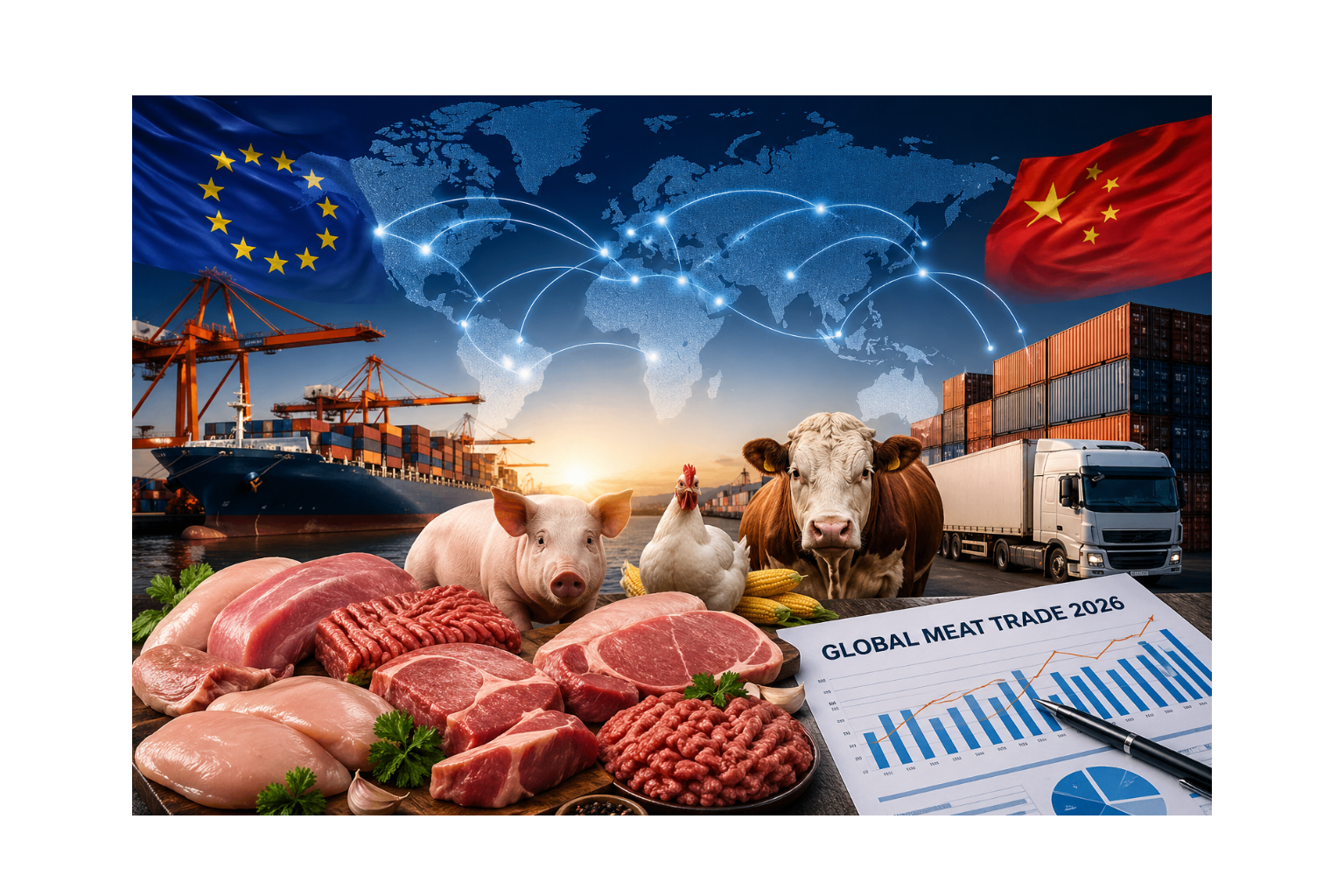
The global meat industry is entering 2026 amid a major reshaping of trade flows, and Romania risks being left behind at a time when major exporting powers are aggressively redirecting their products toward Asia.
According to the latest USDA estimates, global pork production is expected to reach 120.2 million tonnes in 2026, up by approximately 0.6% compared to the previous year. However, international trade remains highly volatile due to animal diseases, trade tariffs, and shifting demand in China.
The biggest change is coming from China itself.
After becoming the world’s largest pork importer between 2019 and 2021 due to the devastating impact of African Swine Fever, the situation has shifted dramatically in 2026. According to USDA and S&P Global, China’s pork imports are expected to decline by 16% this year, as domestic herds recover.
For European exporters, this is bad news.
The European Union is seeing a sharp decline in its presence on the Chinese market: the share of EU exports to China dropped from 54% in 2020 to just 18% in 2025. At the same time, total EU pork exports are projected to fall by a further 8% in 2026.
The situation has been further complicated by new African Swine Fever outbreaks in Spain, the largest pork producer in Europe. Reuters reported that approximately one-third of Spain’s export certificates were blocked, affecting trade with China, Mexico, Taiwan, and the United Kingdom. Spain’s pork industry exports products worth €8.8 billion annually.
In this context, Brazil is emerging as the major winner.
Lower production costs, expanded access to Asian markets, and the potential EU–Mercosur agreement give South America a significant competitive advantage — including within the European market.
Romania, however, enters this global competition with a major vulnerability: its exports remain limited due to sanitary restrictions caused by African Swine Fever.
The European Commission updated ASF restriction zones across the EU as recently as April 2026, and Romania continues to be affected by its epidemiological history.
The paradox is striking.
Romania produces more, but exports little and imports large volumes of higher value-added products.
While major global players are aggressively repositioning their strategies toward markets such as the Philippines, Vietnam, South Korea, and other Asian economies, Romanian producers remain focused almost exclusively on surviving in the domestic market.
In the coming years, the key challenge will no longer be production alone.
It will be about who controls access to Asian markets.
And at this moment, Romania risks standing on the sidelines of the largest global shift in trade flows in the animal protein industry over the past decade.
(Photo: AI GENERATED)
Did you learn something new from this article?
Read also: