779

Author
Meat.Milk
Share on


Published on
2026 April 22
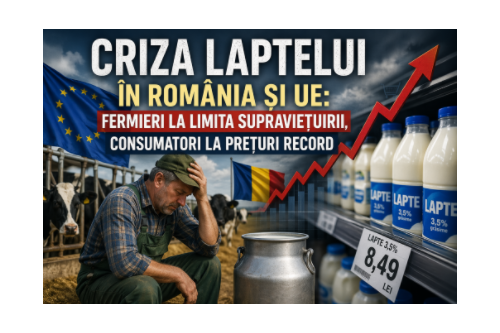
The Romanian dairy sector is going through one of its most difficult periods in recent years, caught between European overproduction, massive imports, and a price squeeze that threatens to push thousands of farms out of the market.
Milk prices: below production costs
The outlook is bleak and continues to worsen by the day. The sharp decline in prices, increasing pressure from imports, and the absence of effective protection mechanisms are directly affecting the viability of local farms. The figures speak for themselves: some processors are offering farmers 1.5 lei per liter, while smaller producers have reportedly been offered as little as 1.2 lei per liter — under conditions in which milk cannot be found on retail shelves for less than 8.5 lei, while producing one liter costs Romanian farmers well above 2 lei.
Spot milk, traded on the open market without stable contracts, has reached catastrophic levels — around 1.1–1.25 lei per liter, according to statements from industry representatives.
The exclusion of small farmers
One of the direct consequences of the crisis is the marginalization of small-scale producers. Processors have begun abandoning milk collection from farms delivering less than 150–200 liters per day, and in some cases factories have completely eliminated collection routes of up to 10,000 liters daily — meaning that many small farmers no longer have access to the market and are being excluded from the supply chain.
In Satu Mare County, 12 farmers have already decided to shut down their businesses due to the collapse in prices — farmers who say they are effectively operating at a loss and no longer see a viable solution.
Causes: European overproduction and the Gulf crisis
The international context is making the situation even more complicated. The crisis has been aggravated by a milk surplus at the European level, caused by disruptions in international exports generated by tensions in the Strait of Hormuz region. Approximately 10–15% of European dairy production was destined for Gulf countries, and the decline in that demand has created a chain reaction across markets throughout Europe.
At the same time, producers are facing significant increases in fertilizer and fuel prices, particularly diesel — costs that have risen without sales prices keeping pace.
A regional phenomenon: Romania and Bulgaria facing the same situation
The downward trend in the average farm-gate price of cow’s milk has been reported across the entire European Union, with Romania and Bulgaria facing similar circumstances driven by common commercial factors. Bulgaria’s Minister of Agriculture warned during a meeting of the EU Agriculture Council that prices have been in continuous decline since the beginning of 2025 — a trend confirmed by 2026 data.
The squeeze: farmers lose, consumers pay more
The paradox of the crisis is that it harms both ends of the supply chain, with the exception of intermediaries. Retailers tend to keep shelf prices unchanged in order to preserve their profit margins, while prices at the farm gate continue to fall. Consumers are already feeling a different type of pressure: retail milk prices have increased by approximately 10% compared to last year.
Food security risk
The scale of the crisis has moved beyond the economic sphere. Representatives from the political sector warn that the situation risks becoming a food security issue, with long-term effects on Romanian agriculture. Many farms are already facing losses exceeding 30% — and in the context of rising energy and fuel prices, those losses could exceed 35–40%, making continued operations impossible.
Romania ranks among the top ten milk producers in the European Union, yet domestic production still fails to cover consumption demand — a situation that continues in 2026. Proposed solutions include support schemes similar to those implemented in Hungary, stricter regulations against unfair commercial practices, and easier access to processing capacities.
The milk crisis will be one of the central topics of debate at the 15th edition of the International Meat.Milk Expo Conference, held at Casino Sinaia.
(Photo: AI GENERATED)
Did you learn something new from this article?
Read also: