661

Author
Meat.Milk
Share on


Published on
2026 October 28
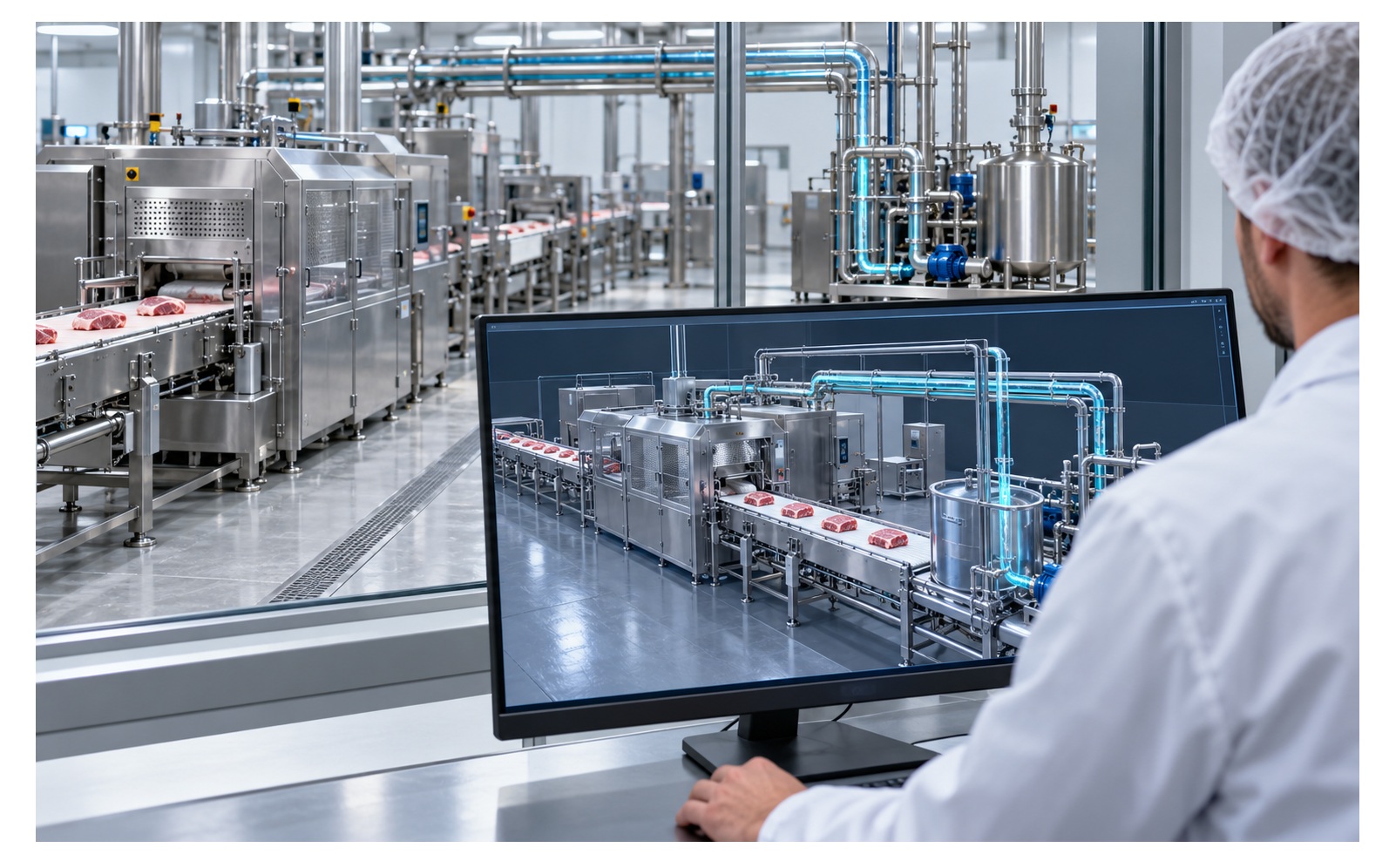
A change to a production flow may look convincing in a technical proposal. The question is how it will perform under actual factory conditions. Digital twin technology allows scenarios to be evaluated in a model connected to the real system before changes are made to the equipment. Its usefulness, however, depends on data quality and the validation of its predictions.
For a processor, the objective is practical: to compare alternatives and understand the consequences of a change before committing resources. Research by the US National Institute of Standards and Technology (NIST) describes the use of digital twins in the design, simulation, operation and maintenance of industrial equipment and processes.
What distinguishes a digital twin from a 3D representation?
A digital twin represents a piece of equipment, a process or a facility and is synchronised with it at a defined frequency and level of fidelity. Historical and operational data support the analysis of system behaviour and the exploration of future scenarios.
The technology’s value therefore lies in the relationship between the model, the measurements and the decision it is designed to support. A detailed image of a factory does not, on its own, demonstrate an ability to predict how it will operate.
An example from meat processing
The Hydroless project, presented by the Universitat Politècnica de Catalunya, addresses water consumption in the meat industry through artificial intelligence and digital twins.
The project description sets out two areas of work: monitoring and optimising consumption at bonÀrea’s plant in Guissona, and developing a digital twin for Friselva’s facilities in Riudellots de la Selva. In Friselva’s case, the stated objective is to evaluate redesign options that would facilitate water recirculation in processing areas.
The source describes the application and the project’s objectives without publishing a percentage reduction in water consumption achieved. The example therefore illustrates an industrial problem that can be investigated, without supporting universal promises of consumption savings.
How much confidence can you place in a simulation?
NIST emphasises that the support provided to decision-making depends on the model’s credibility. This requires verification, validation and uncertainty quantification throughout its use. Results must be assessed against the purpose for which the digital twin was developed.
For factory management, discussions with a supplier should begin with precise questions: what decision will the model support, what data does it require, how do its predictions compare with measurements, and under what conditions do they remain valid?
A clearly defined project can start with a single process. The investment criterion is its demonstrated ability to address an operational problem, with a known level of uncertainty and results that can be verified in the factory.
Did you learn something new from this article?
Read also: