271

Author
Meat.Milk
Share on


Published on
2026 November 23
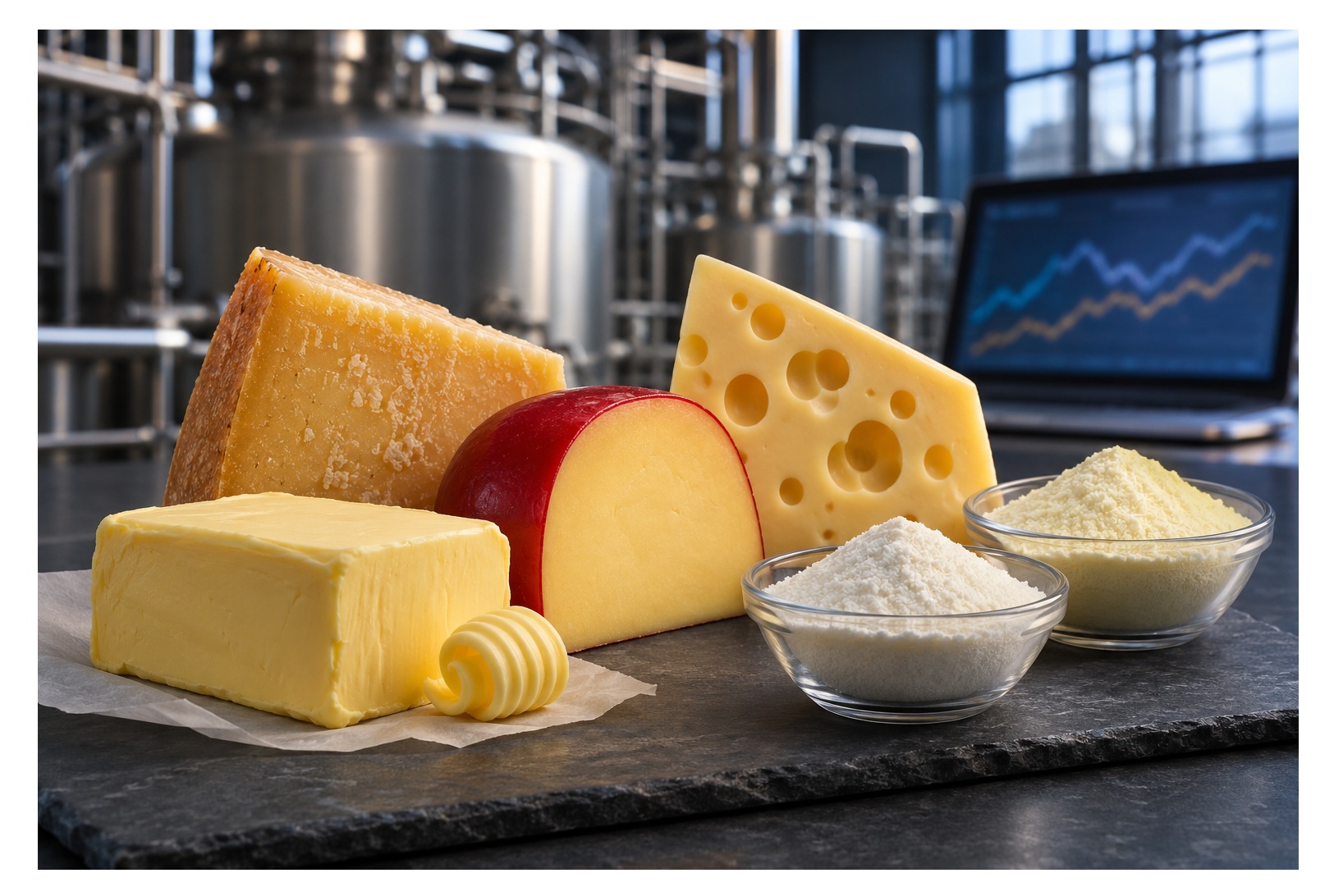
Seven of the eight dairy products tracked in the European Commission’s price series recorded weekly increases in mid-November. The year-on-year comparison, however, paints a different picture: butter and all four monitored cheeses remain below their 2025 levels, while milk powders and whey powder have gained value. For processors, these developments bring renewed attention to the value generated by each use of milk.
Butter and Cheddar rise, but the recovery remains limited
In week 46, ending on 15 November 2026, the butter quotation reached €407.14/100 kg, up 0.4% on the previous week. Compared with the corresponding period in 2025, however, the price remains 28.6% lower.
Cheddar recorded the strongest weekly increase among the products analysed: 1.7%, reaching €326.10/100 kg. This rise does not close the year-on-year gap of −25.0%.
Edam and Gouda recorded similar weekly increases of 0.3%, reaching €389.81/100 kg and €400.84/100 kg, respectively. Compared with the same week in 2025, prices were down 6.1% for Edam and 12.0% for Gouda.
Emmental was the only product in the monitored series to lose ground week on week: its quotation fell by 2.2% to €535.72/100 kg, standing 13.7% below the year-earlier benchmark.
Milk powders and whey retain their year-on-year gains
Skimmed milk powder reached €353.45/100 kg, with a weekly increase of 0.2% and a year-on-year rise of 64.4%. Whole milk powder stood at €387.06/100 kg, up 1.0% week on week and 12.5% year on year.
Whey powder reached €160.61/100 kg. The weekly movement was modest, at +0.3%, but the difference from the same period in 2025 remained substantial: +57.0%.
These are European average quotations for distinct products. Developments in whey powder do not automatically describe the market for protein concentrates or isolates.
Exports add a commercial perspective
The Commission’s dashboard, updated on 18 November, reports exports to third countries of 185,805 tonnes of butter and 863,383 tonnes of cheese in January–July 2026. The published increases are 37% and 6%, respectively.
Growth in export volumes during the first seven months thus coexists with November prices below their year-earlier benchmarks for butter and cheese. The indicators cover different periods and dimensions of the market; the relationship between them cannot be reduced to a single explanation.
For factories, the relevant analysis remains the relationship between the cost of milk and the revenue achievable from the resulting products, taking account of yields, input consumption and contracts. A rising quotation can improve the commercial outlook; its effect on profitability must be demonstrated through each factory’s own results.
Did you learn something new from this article?
Read also: