793

Author
Meat.Milk
Share on


Published on
2026 August 14
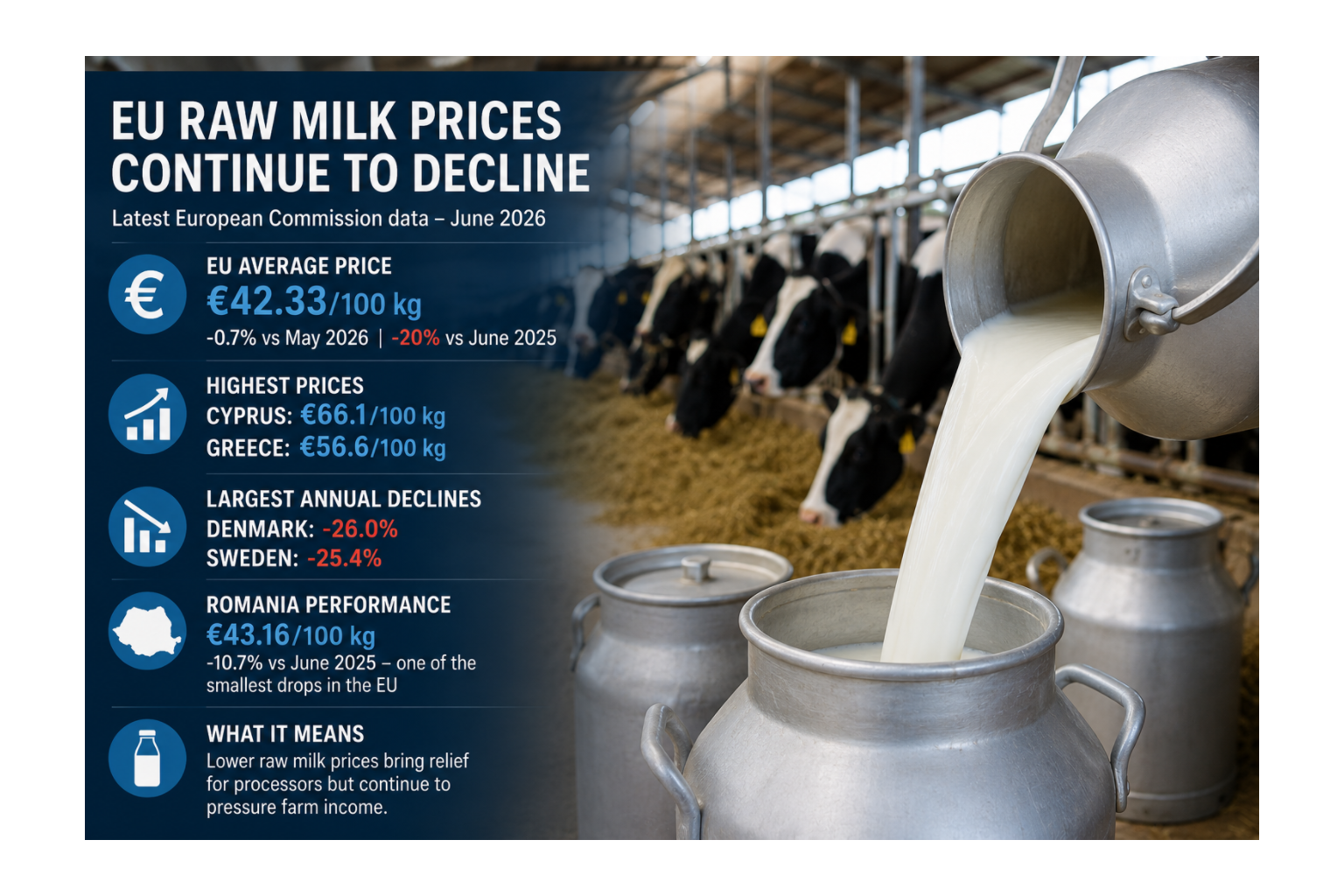
The latest European Commission Milk Market Observatory confirms that EU raw milk prices continued their downward trend in June 2026, reflecting improved milk availability and easing pressure on processors' procurement costs. However, significant differences between Member States remain, with Romania posting one of the smallest annual price declines in the Union.
EU average falls to €42.33/100 kg
The average farmgate milk price across the EU reached €42.33/100 kg in June 2026, down 0.7% from May (€42.61/100 kg) and 20.0% lower than in June 2025. The Commission's estimated price for July falls further to €41.84/100 kg, suggesting the downward correction is continuing through the summer.
Despite the recent decline, current prices remain close to the 2021–2025 historical average, indicating that the market is normalising after the exceptional highs recorded during 2024 and early 2025.
Romania among the most resilient markets
Romania recorded an average raw milk price of €43.34/100 kg in June 2026, above the EU average and representing a 10.7% year-on-year decrease. This is one of the smallest annual declines among EU Member States, highlighting the relative stability of the Romanian dairy market compared with many Western and Northern European countries.
Only Greece (+1.7%), Cyprus (+0.6%), Malta (+0.9%), Croatia (-1.1%), Portugal (-5.3%), Finland (-4.8%) and Spain (-5.5%) reported stronger year-on-year performances.
Wide differences across the European Union
Cyprus remained the highest-priced milk market in the EU at €66.12/100 kg, followed by Malta (€63.66/100 kg) and Greece (€56.60/100 kg). At the opposite end of the market, Lithuania recorded the lowest milk price at €34.80/100 kg, followed by Hungary (€36.50/100 kg) and Slovakia (€36.63/100 kg).
The largest annual price declines were observed in Lithuania (-30.4%), the Netherlands (-26.9%), Hungary (-26.4%), Germany (-25.6%), the Czech Republic (-25.2%) and Denmark (-25.1%), reflecting a broad market correction after last year's exceptionally high milk prices.
What it means for dairy processors
For dairy processors, lower raw milk prices reduce procurement costs and improve processing margins, particularly for commodity products such as butter, skimmed milk powder and cheese. At the same time, lower farmgate prices continue to pressure producer profitability, especially in countries experiencing declines exceeding 20%.
The latest European Commission figures suggest that the EU dairy market is entering a more balanced phase, with milk prices gradually stabilising at levels that remain historically solid but considerably below the peaks reached in 2025. For processors, this creates a more predictable purchasing environment, while producers continue to face tighter margins and increased pressure to improve efficiency.
Did you learn something new from this article?
Read also: