222

Author
Meat.Milk
Share on


Published on
2026 November 13
In early November, the EU price for light lambs rose above €1,100 per 100 kg carcass weight, while the price for heavy lambs remained almost unchanged from the previous week. In Romania, slaughter figures showed a different trend from the EU as a whole: output rose slightly while it fell across the bloc.
Light lamb prices rise faster
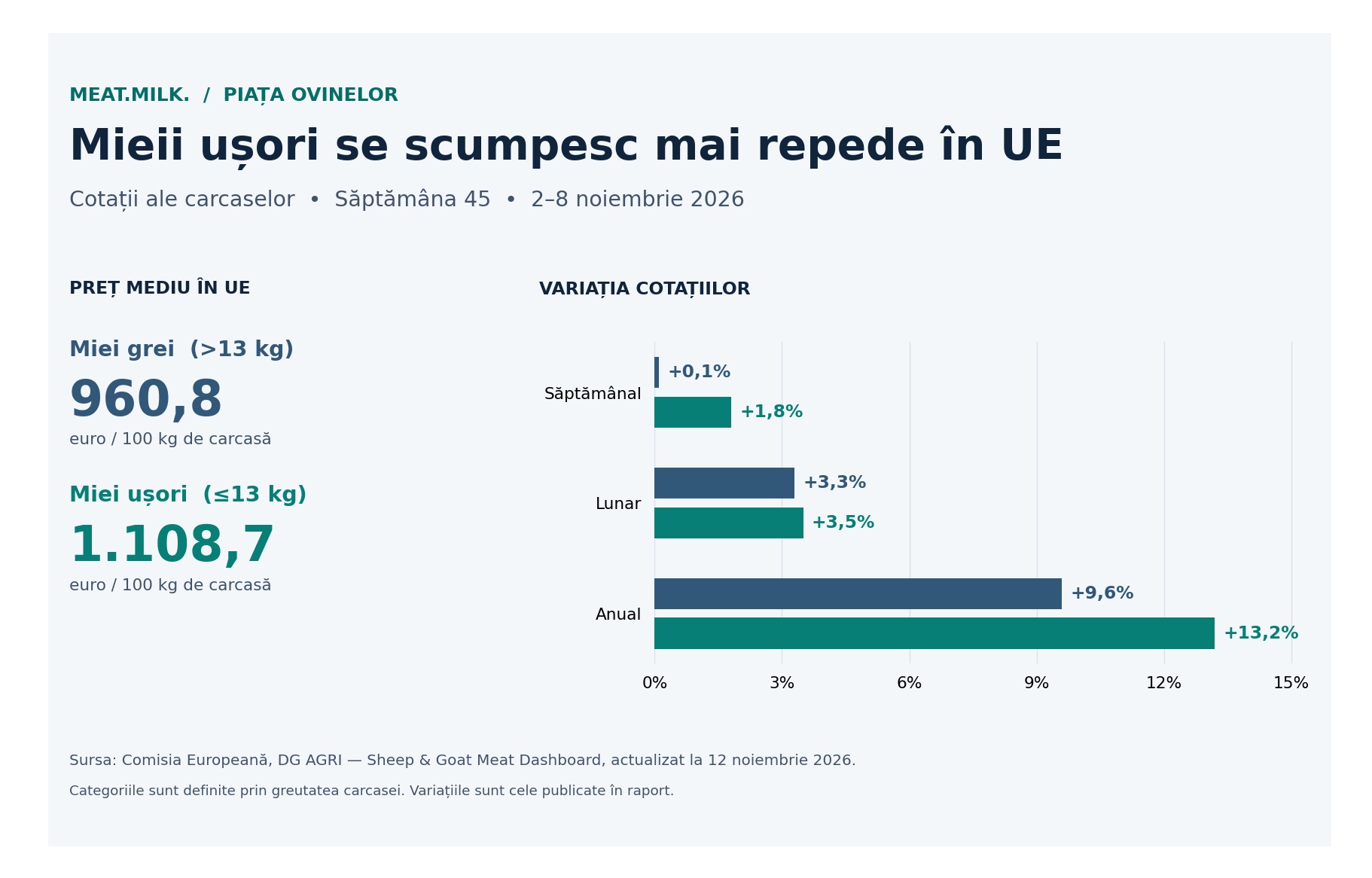
The European Commission’s report, updated on 12 November 2026, shows that in week 45, from 2 to 8 November, light lambs with a carcass weight of 13 kg or less were quoted at €1,108.7 per 100 kg carcass weight. The price rose by 1.8% week on week, by 3.5% against the monthly benchmark and by 13.2% compared with the corresponding period in 2025.
For heavy lambs, with carcasses weighing more than 13 kg, the price reached €960.8 per 100 kg carcass weight, up 0.1% week on week, 3.3% against the monthly benchmark and 9.6% year on year.
The difference, calculated from the published figures, is €147.9 per 100 kg carcass weight. A higher price per 100 kg does not automatically translate into higher revenue per animal. For producers, the comparison depends on the actual carcass weight and the terms of sale.
Romania: output edges up as EU volumes decline
In the first eight months of 2026, the volume of sheep meat produced in EU slaughterhouses fell by 0.4% compared with the same period in 2025. Romania reported 10,900 tonnes, up 1%. Over the same period, Spain recorded 61,200 tonnes (−6%), France 48,100 tonnes (+3%) and Ireland 34,400 tonnes (−2%).
EU price quotations provide a benchmark for negotiations. Slaughter figures, however, show the volume reported by slaughterhouses and do not indicate the prices Romanian producers received.
Algeria is the leading destination for EU exports
Between January and July 2026, EU exports of sheep and goat meat rose by 8% to 66,073 tonnes in carcass weight equivalent. Shipments to Algeria increased by 57% to 31,095 tonnes, accounting for approximately 47% of the total. Over the same period, EU imports fell by 3% to 114,848 tonnes.
For Romanian businesses, these figures offer different points of reference: price quotations help compare carcass categories, while trade flows show where EU shipments have increased. The value of an order, however, is determined by the terms of the contract: the buyer’s specifications, the accepted weight and the negotiated price.
Did you learn something new from this article?
Read also: