853

Author
Meat.Milk
Share on


Published on
2026 January 22
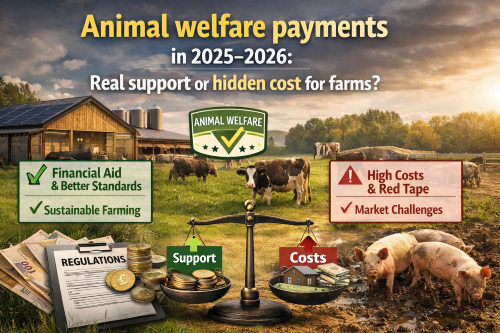
Animal welfare payments represent, in the 2025–2026 period, one of the instruments through which the Common Agricultural Policy links financial support to the requirements of sustainable production. From a legislative standpoint, these payments are granted only to farms that go beyond the mandatory minimum standards, which turns them into a selective economic mechanism.
Data from the European Commission indicate that, at European Union level, the costs associated with improving animal welfare conditions can account for between 5% and 15% of the operational costs of livestock farms, depending on the species and the production system. Public support covers these expenses only partially, with the difference being borne directly by farmers.
From an economic perspective, these payments are particularly advantageous for well-capitalized operations, which can absorb the initial investments without significantly affecting cash flow. For farms operating on low margins, the additional obligations can generate financial pressure, especially in the absence of market prices that reflect the increased costs.
In 2026, animal welfare is no longer merely an ethical or administrative requirement, but an economic parameter that directly influences the competitiveness and sustainability of livestock farms.
(Photo: AI GENERATED)
Did you learn something new from this article?
Read also: