981

Author
Meat.Milk
Share on


Published on
2026 January 27
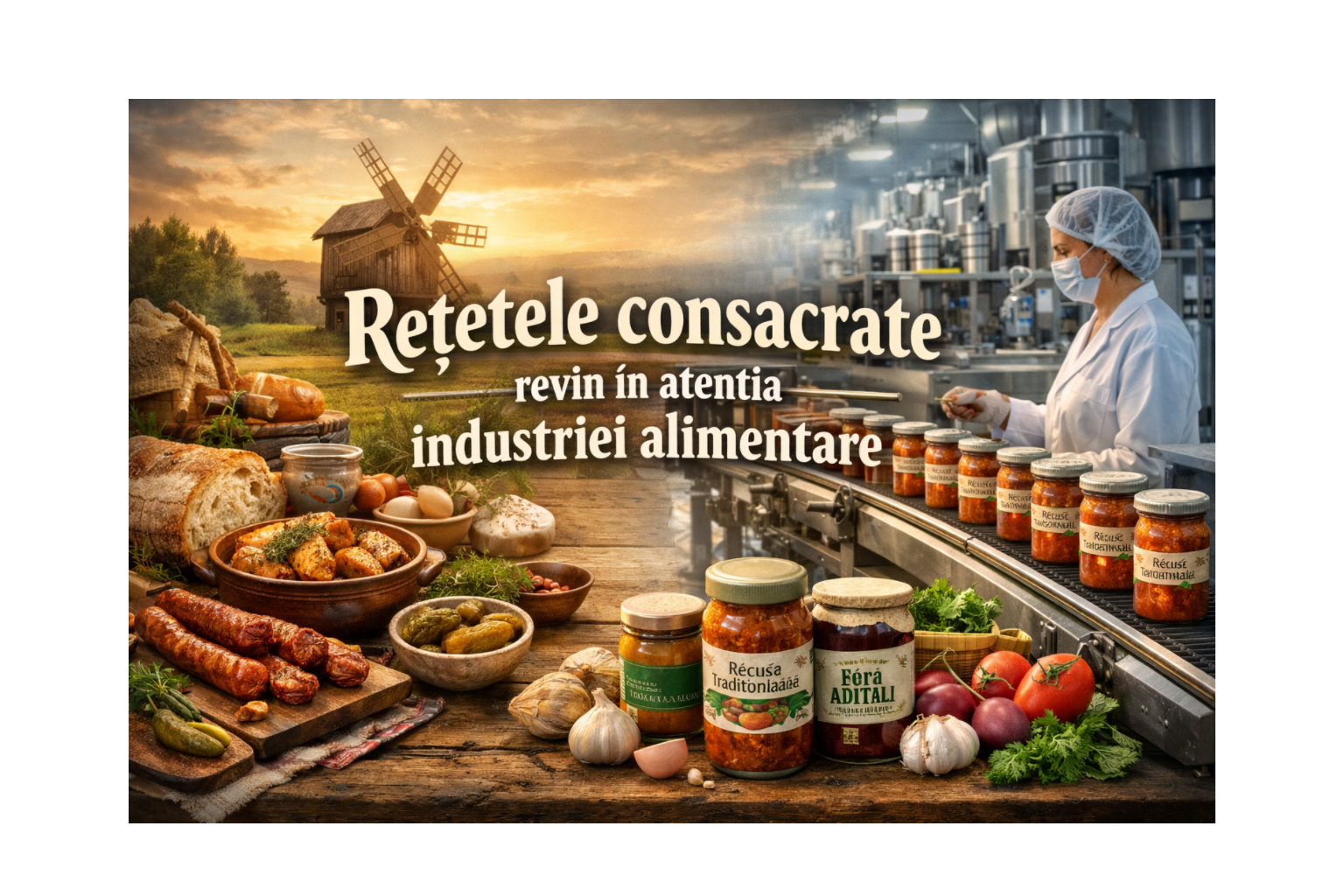
Since 2021, the Romanian food industry has had a clear legal instrument through which historical recipes can be officially recognised and transformed into a competitive advantage. Through Joint Order of the Ministry of Agriculture and Rural Development (MADR) No. 151/1,460/213/2021, the state established the framework for the registration of traditional recipes and for the certification of products manufactured in accordance with them, within a national system of records and control.
The concept of a “traditional recipe” refers to compositions and manufacturing technologies documented as being in use prior to 1975, with precise ingredient proportions and clearly defined technological parameters. This is not about modern reinterpretations or nostalgic marketing, but about authentic industrial recipes that are standardised and verifiable.
The procedure takes place in two distinct stages. The first involves the registration of the recipe in the National Register of Traditional Recipes, based on historical documentation and complete technical specifications. Subsequently, any processor that strictly complies with the registered recipe may apply for the certification of its product in the National Register of Products Certified in Accordance with Traditional Recipes. Certification is granted for a period of five years and entails compliance inspections, laboratory analyses, and continuous adherence to the declared technology.
For consumers, the system provides transparency and the assurance of an authentic recipe. For processors—particularly in the meat and dairy sectors—the mechanism offers genuine market differentiation backed by official recognition. Certified products can clearly communicate compliance with a historical Romanian production technology, at a time when authenticity and consistency of quality are becoming increasingly important in purchasing decisions.
From an economic perspective, traditional recipes can support premium positioning, strengthen brand trust, and serve as a solid argument in investment projects and applications for public funding. They do not replace European product protection schemes, but rather complement the national quality architecture with an instrument tailored to the realities of Romania’s industrial food sector.
In practical terms, the Romanian state is beginning to treat food tradition not as a storytelling element, but as a recognised and protected technological standard.
In a context of intensifying competition and price pressure, traditional recipes may become one of the few tools through which the local food industry can add genuine value to its products.
(Photo: AI-generated)
Did you learn something new from this article?
Read also: