548

Author
Meat.Milk
Share on


Published on
2026 September 21
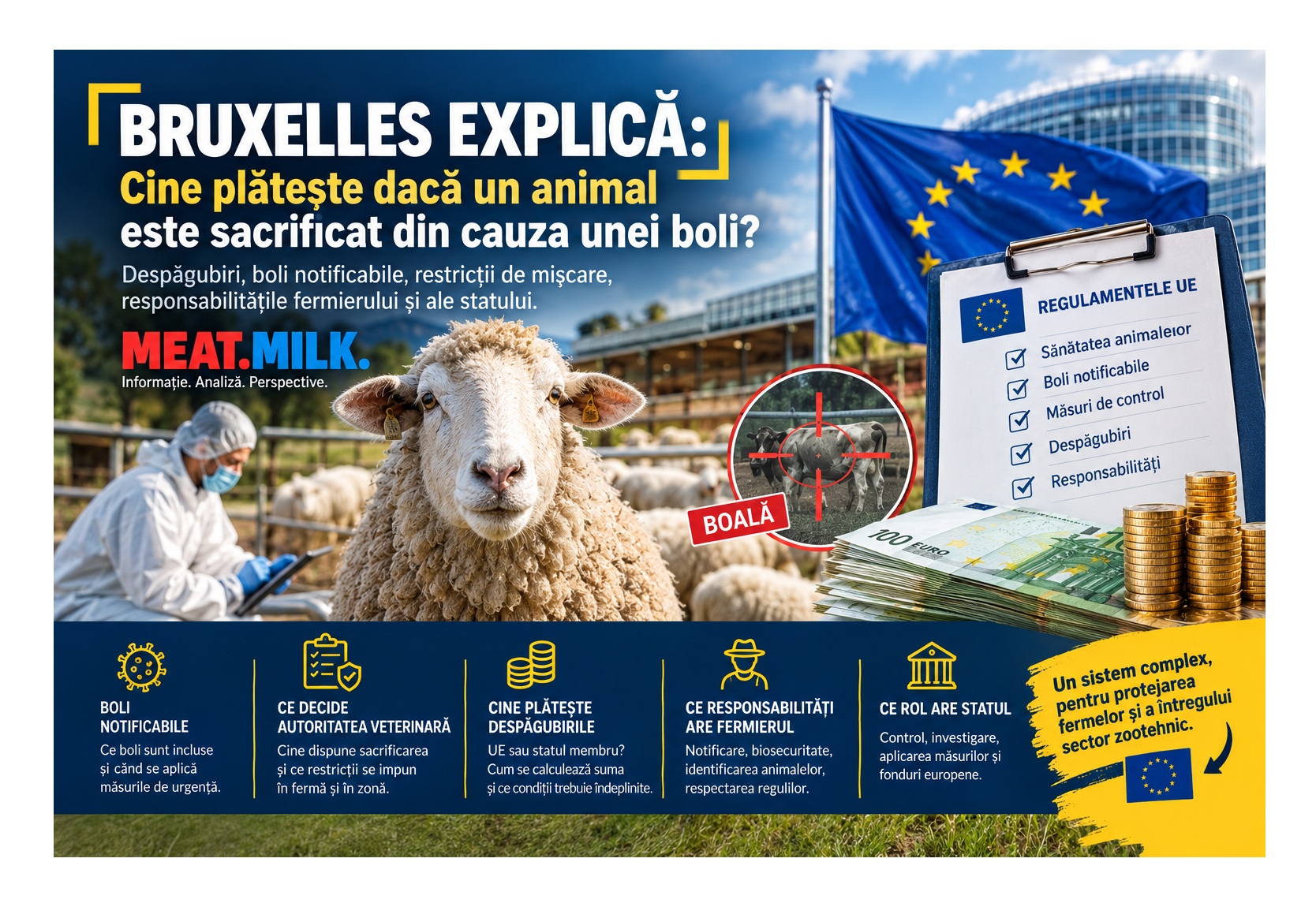
From Disease Suspicion to Compensation: What Obligations Does the Farmer Have, What Can the Veterinary Authority Order, and How Does the Compensation Mechanism Work in the European Union and Romania
For a livestock farmer, one of the most serious scenarios is the emergence of a transmissible disease on the farm. The problem is not limited to the loss of the diseased animal. In certain situations, the authorities may order the slaughter of healthy or suspected animals, restrict the movement of animals and products, isolate the holding, and establish protection and surveillance zones.
The question that immediately arises is an economic one: who bears the loss?
The answer is not simple, but the European framework is clear: when the competent authority imposes eradication measures for certain diseases, EU legislation allows owners to be compensated for animals slaughtered, within the limits established by European and national rules. In Romania, there is a national compensation mechanism for animals slaughtered, killed or otherwise affected for the purpose of eliminating outbreaks of transmissible diseases.
It is important, however, to understand that compensation is not automatic in every situation and for every disease. There are conditions, assessment procedures, and situations in which the owner may lose the right to compensation.
1. Why can an animal that appears healthy be slaughtered?
The European animal health system is based on an essential principle: in the case of diseases with a high potential for spread, the authorities must act before the disease is transmitted to other holdings.
Regulation (EU) 2016/429, known as the Animal Health Law, is the EU’s central framework for the prevention and control of transmissible animal diseases and has applied since 21 April 2021. It establishes responsibilities for operators, veterinarians and authorities and also regulates disease notification, biosecurity, traceability, animal movements and emergency measures.
In the case of Category A diseases, the rule is particularly strict: these are diseases that normally do not occur in the Union and for which immediate eradication measures must be taken when they are detected.
Among the diseases classified as Category A are, for the relevant species, foot-and-mouth disease, African swine fever, classical swine fever, epizootic haemorrhagic disease, lumpy skin disease, peste des petits ruminants and highly pathogenic avian influenza, depending on the combination of disease and species covered by the legislation. The classification and relevant species are established by Commission Implementing Regulation (EU) 2018/1882.
In such a case, slaughter is not necessarily limited to animals displaying clinical signs.
For example, with regard to foot-and-mouth disease, the European Commission explains that measures are based on the rapid elimination of the outbreak and may include the slaughter of infected animals and animals in contact with them, as well as regional restrictions on the movement of animals and products.
The reason is epidemiological: an apparently healthy animal may be infected and may contribute to the spread of the disease.
2. The first critical stage: suspicion
The procedure does not begin with compensation, but with the detection and notification of the suspicion.
The Animal Health Law establishes obligations for operators who keep animals. They must inform the competent authority when there are reasons to suspect the presence of certain listed diseases, but also in the event of abnormal mortality or other signs of serious disease of unknown cause.
In the event of a suspicion of a Category A disease, Commission Delegated Regulation (EU) 2020/687 requires the operator to take immediate measures to limit the risk of spread.
These include, among others:
- isolation of suspected animals;
- additional biosecurity measures;
- stopping the movement of animals to and from the holding;
- restricting the movement of products, materials and substances that could be contaminated;
- updating production, health and traceability records;
- compliance with the instructions of the competent authority.
At the same time, the competent authority must investigate the suspicion, including through clinical examination of the animals and the collection of samples for laboratory testing.
In other words:
the farmer does not decide on his own which animals are to be slaughtered, and the authority cannot ignore the suspicion.
The system operates through a sequence of measures: notification → investigation → restrictions → confirmation or exclusion → control measures.
3. What happens to the farm until the disease is confirmed?
An important but less well-known aspect is that restrictions may begin before laboratory confirmation.
In the event of a suspicion of a Category A disease, the competent authority may place the holding under official surveillance and may prohibit the movement of animals and certain products or materials to and from the holding. The slaughter of animals is also restricted, except in situations authorised by the competent authority.
If the disease is confirmed, the authority introduces the control measures provided for by the legislation.
For Category A diseases, depending on the disease and the situation, these measures may include the establishment of restricted zones, with special rules governing the movement of animals, products and persons.
The European Commission states that EU legislation provides for protection zones, surveillance zones and, in certain situations, infected zones, as well as prohibitions and special conditions for authorised movements.
4. Who decides on slaughter?
The decision to apply eradication measures rests with the competent authority, within the framework established by European and national legislation.
For a Category A disease, Commission Delegated Regulation (EU) 2020/687 establishes the measures to be applied in cases of suspicion and confirmation. In certain epidemiological situations, the authority may also order the preventive killing of certain animals on the suspected holding.
This is essential to understanding the financial mechanism:
the farmer does not slaughter his animals on his own initiative and then automatically request their value in compensation.
Compensation is linked to the control and eradication measures ordered within the official framework for combating the disease.
5. But who pays?
This is where the European and national mechanisms come into play.
At EU level, Regulation (EU) 2021/690 allows the financing of certain costs incurred by Member States for veterinary emergency measures.
Eligible costs include:
- compensation to owners for animals slaughtered or culled;
- the costs of slaughtering or culling;
- associated transport costs;
- compensation for certain animal products destroyed;
- the costs of cleaning, disinfestation and disinfection of holdings and equipment.
For animals, the European rule establishes as a limit the market value that the animals would have had if they had not been affected by the disease. Any residual value, where applicable, is taken into account in accordance with the applicable rules.
An important nuance is that the EU does not, as a general rule, pay the farmer directly.
The mechanism is structured so that the Member State bears the costs of eligible measures and may receive a financial contribution from the Union under the conditions laid down by European legislation and approved programmes.
Therefore, for the farmer, the primary administrative interlocutor is the competent national authority, not the European Commission.
6. How does the mechanism work in Romania?
In Romania, the main framework for compensating owners is established by Government Decision No. 1,214/2009 on the methodology for determining and paying compensation due to owners of animals slaughtered, killed or otherwise affected for the purpose of the rapid eradication of outbreaks of transmissible diseases.
The consolidated version available on the Legislative Portal includes amendments, including one from December 2025.
According to the legislation, in the case of measures aimed at the rapid eradication of outbreaks, including in certain cases of suspicion, where these involve the slaughter or killing of animals, compensation is granted, taking into account the amounts obtained from the sale of products and by-products.
The Government Decision provides that owners whose animals are kept in compliance with veterinary sanitary rules, including requirements concerning the declaration and identification/registration of animals, are eligible for compensation when they have suffered losses as a result of the application of disease control measures under the national framework.
An important element is that Romanian legislation covers not only slaughtered animals, but also certain collateral losses resulting from the implementation of disease control and eradication measures.
7. Compensation does not always mean “the price we wanted”
One of the most important aspects for the farmer is how the amount is determined.
In Romania, the value is established by an assessment committee.
According to Government Decision No. 1,214/2009, the committee includes representatives of the veterinary authority, the relevant agricultural/livestock structures, the local disease-control decision-making structure and the local authority.
The assessment takes into account elements such as:
- genetic value;
- breeding value;
- sex;
- age;
- weight;
- physiological condition;
- production category;
- market price on the date the outbreak is eradicated.
Therefore, compensation is the result of a documented assessment, not a fixed amount arbitrarily established for each animal.
8. There is, however, an essential condition: the farmer must have complied with the rules
This is one of the most important differences between public compensation and ordinary commercial insurance.
In Romania, Government Decision No. 1,214/2009 provides for situations in which the owner is not entitled to compensation.
These include:
- failure to notify the veterinarian or veterinary sanitary authority of changes in the animal health status;
- failure to report illness, suspicion of disease, death or emergency slaughter within the prescribed period;
- failure to comply with hygiene and biosecurity rules;
- introduction of animals without the required veterinary sanitary documents;
- introduction of animals originating from holdings or areas subject to disease-control programmes;
- violations of the legislation established by the competent authorities.
The legislation also provides that compensation is not granted to persons sanctioned for contraventions under the conditions laid down by the Government Decision.
This rule sends a very clear message:
the compensation system is linked to compliance with biosecurity, identification, notification and control obligations.
9. How much time does the farmer have to report the situation?
Under the Romanian framework established by Government Decision No. 1,214/2009, the owner must notify the official veterinarian, the authorised private-practice veterinarian or the Directorate for Veterinary Sanitary and Food Safety (DSVSA) of the occurrence of illness, suspected disease, deaths or emergency slaughter within a maximum of 48 hours, by written or telephone notification, in accordance with the conditions set out in the legislation.
Failure to report within the prescribed period is also established as a contravention, punishable by a fine of RON 3,000–6,000.
The same Government Decision penalises, among other things, failure to isolate sick or suspected animals, failure to comply with movement restrictions and failure to comply with biosecurity rules.
In practice, this is one of the most important lessons of the system: the speed with which the farmer reports a suspicion may matter both for disease control and for his legal and financial position.
10. What happens to animals in the protection zone?
A restricted zone does not automatically mean that all animals within that zone will be slaughtered.
The measures depend on the disease, its category, the epidemiological situation and the risk assessment.
EU legislation allows the establishment of protection and surveillance zones and the introduction of rules governing the movement of animals and products. Under certain conditions, movements may be authorised by the competent authority following a risk assessment and subject to compliance with biosecurity measures.
For the farmer, however, the economic impact can be significant even without the actual slaughter of the herd.
Restrictions may mean:
animals that cannot be sold → delayed shipments → products that cannot be moved → additional costs → loss of income.
Romanian legislation provides for the possibility of compensation for certain collateral losses resulting from eradication and control measures.
11. What role does the State play?
The State has several responsibilities, not merely the payment of compensation.
Under the European system, the competent authority must ensure surveillance, investigation of suspicions and implementation of control and eradication measures.
The Animal Health Law clarifies the responsibilities of farmers, veterinarians and authorities and places emphasis on prevention, biosecurity, surveillance, traceability and rapid intervention.
In the event of a suspicion of a Category A disease, the authority must immediately conduct an investigation to confirm or rule out the disease.
At European level, there is also the Animal Disease Information System – ADIS, the system through which Member States transmit information on disease outbreaks.
For a primary outbreak, notification to the system must be submitted within 24 hours of confirmation of the outbreak, in accordance with European rules.
12. But what are the farmer’s responsibilities?
Responsibility does not begin when the disease appears.
The Animal Health Law is based on the principle that operators must contribute to the prevention and early detection of diseases.
Relevant responsibilities include:
Biosecurity The farmer must take measures to reduce the risk of introducing and spreading diseases.
Herd surveillance Signs of disease and abnormal mortality must be observed and reported.
Traceability Animals and holdings must be identifiable and traceable in accordance with the legislation.
Notification Relevant suspicions must be communicated to the competent authority.
Compliance with restrictions Once official measures have been imposed, the farmer may not move animals or products at his own discretion.
Cooperation with the veterinary authority The operator must provide the requested information and records and comply with control measures.
13. Why does the State pay for a slaughtered animal?
From the perspective of veterinary public health policy, compensation also has a practical role.
If the owner knows that, in the event of an officially ordered slaughter, he may receive compensation under the law, there is an economic incentive to report the suspicion promptly rather than conceal the disease.
At the same time, compensation is linked to compliance with the rules. If the farmer conceals the disease, fails to comply with biosecurity requirements or introduces animals without the required documents, Romanian legislation provides for the loss of the right to compensation in the situations established by law.
Thus, the mechanism seeks to reconcile two interests:
protecting the livestock sector and public health while limiting the economic loss borne by an owner who complies with the rules.
14. Is compensation guaranteed for every disease?
No.
This is one of the most important points to remember.
At European level, there are different categories of diseases, with different obligations and measures. Regulation 2018/1882 classifies diseases into Categories A, B, C, D and E, depending on the control objective: from immediate eradication to surveillance or the prevention of spread through animal movements and trade.
In Romania, Government Decision No. 1,214/2009 provides for a national list of diseases for which compensation is granted, a list that may be updated by order of the President of the National Sanitary Veterinary and Food Safety Authority (ANSVSA).
Therefore, before assuming that a loss will be compensated, the following must be verified:
- the disease;
- the animal species;
- the measure ordered by the authority;
- the status of the holding;
- compliance with veterinary sanitary obligations;
- the documents and assessment of the loss;
- the national framework applicable at the relevant time.
15. Who ultimately bears the bill?
The correct answer is: several levels of the public system may participate in financing, depending on the applicable mechanism.
In Romania, compensation payments are provided from funds managed through the budget of the National Sanitary Veterinary and Food Safety Authority (ANSVSA), under the conditions of national legislation.
At European level, Regulation (EU) 2021/690 allows the provision of a Union financial contribution for certain eligible veterinary costs incurred by Member States, including compensation for animals slaughtered or culled as part of emergency measures or veterinary programmes.
Therefore, two things must not be confused:
who pays the farmer and who may subsequently contribute to financing the State’s measures.
For the owner, the compensation procedure is carried out through the competent national authorities.
16. A simplified example
Let us assume that a suspicion of a disease for which the legislation requires eradication measures is identified on a holding.
Stage 1 – the farmer observes the signs
The animals display unusual symptoms or deaths occur.
Stage 2 – notification
The farmer notifies the veterinarian/competent authority, in accordance with the applicable obligations.
Stage 3 – restrictions
The holding may be placed under surveillance, while the movement of animals and products may be restricted.
Stage 4 – investigation
Veterinarians conduct examinations and samples are collected.
Stage 5 – confirmation
If the disease is confirmed, the authority applies the measures provided for by EU and national legislation.
Stage 6 – slaughter
If slaughter is ordered, it is carried out as part of the official control measures.
Stage 7 – assessment
In Romania, the competent committee determines the amount of compensation in accordance with the criteria laid down by law.
Stage 8 – payment
Compensation is granted if the legal conditions are met and the documentation is approved.
This is, essentially, the path from the slaughtered animal to compensation for the owner.
17. What farmers need to know before any outbreak
Beyond the legislation, the most important message is a very practical one.
A livestock farmer should always have:
- animals identified and registered in accordance with the requirements;
- up-to-date farm records;
- movement documents properly kept;
- an implemented biosecurity plan;
- up-to-date contact details for the veterinarian;
- clear procedures for isolating suspected animals;
- records of entries into and exits from the farm;
- documents concerning treatments and animal health status;
- a clear mechanism for promptly reporting suspicions.
In the event of an outbreak, the farm’s documentation may become just as important as the animal itself, because the assessment and granting of compensation depend on compliance with the legal conditions and the existence of the necessary documentation.
Conclusion: compensation is part of the control system, not unconditional insurance
In the European Union, the control of transmissible animal diseases is based on a system in which the farmer, veterinarian and public authority have distinct responsibilities.
When a disease requires the slaughter of animals, European legislation allows owners to be compensated under the conditions established by EU law and national legislation. In Romania, there is an explicit compensation mechanism for animals slaughtered, killed or otherwise affected as part of measures to eliminate outbreaks.
But the money does not come automatically.
Compliance with biosecurity requirements, animal identification, prompt notification of suspicions, compliance with restrictions and cooperation with the veterinary authority are essential elements of the mechanism.
Ultimately, the system seeks to address a problem that goes beyond the loss of a single farm: how to stop a disease before the economic loss develops into a crisis for an entire livestock sector.
Did you learn something new from this article?
Read also: