485

Author
Meat.Milk
Share on


Published on
2026 September 18
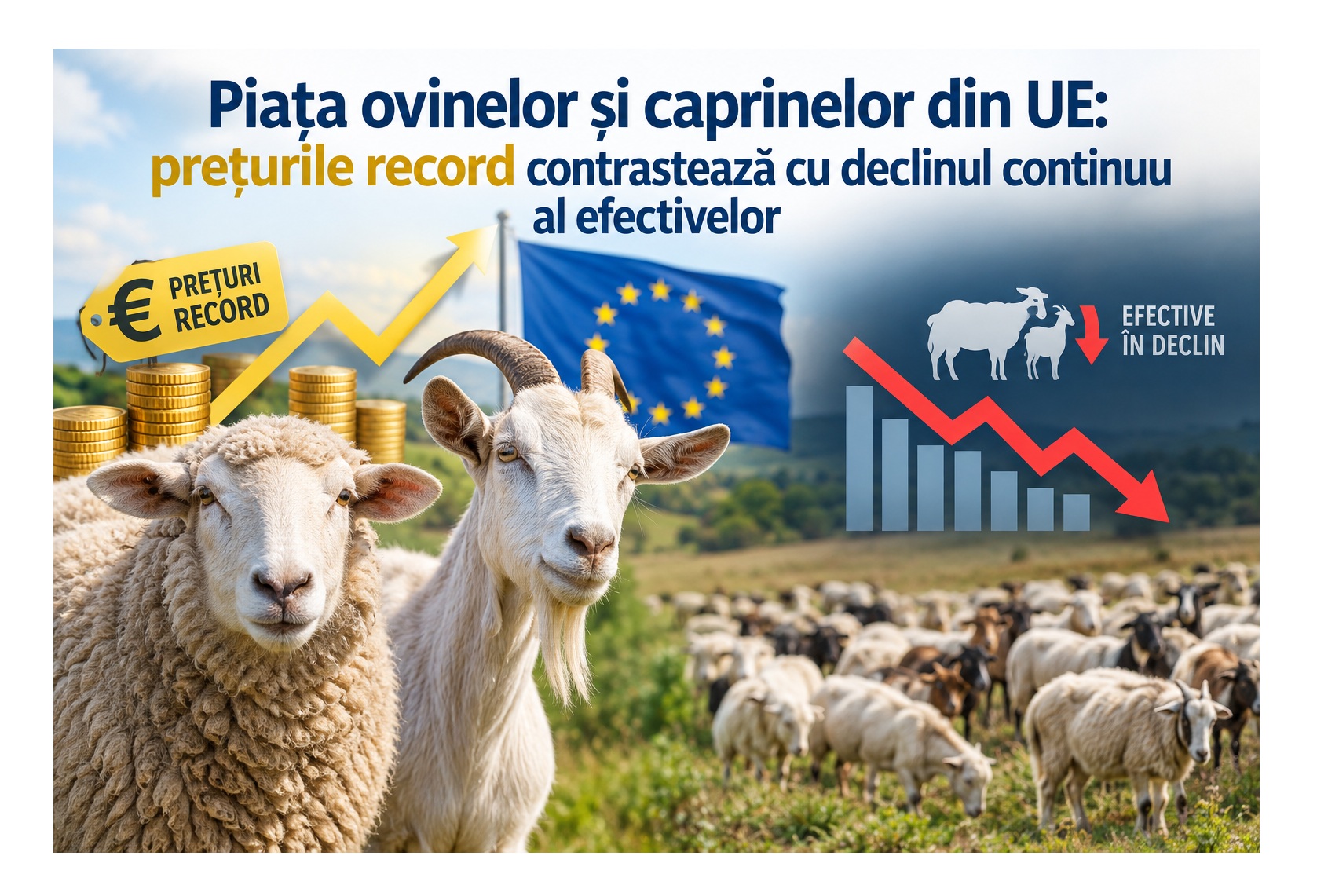
Brussels – The latest European Commission dashboard on the sheep and goat meat market, updated on 16 September 2026, reveals a sector under increasingly visible structural pressure: prices are reaching historic levels, but these are largely being sustained by an accelerated contraction in European livestock numbers and production.
Prices at record highs, despite weekly stagnation
In week 37 of 2026, the price of heavy lamb (over 13 kg carcass weight) stood at EUR 900.2/100 kg, up a modest 0.4% from the previous week, but 3.7% higher than during the same period last year. Light lamb (under 13 kg carcass weight) remained stable at EUR 988.5/100 kg compared with the previous week, while the year-on-year movement is considerably more pronounced: +6.4%.
The trend charts show that, following a significant peak recorded in the first part of 2026 – when heavy lamb prices exceeded EUR 1,000/100 kg – the market moderated towards the end of summer, returning to a level of approximately EUR 900/100 kg. It should be noted that, since week 22 of 2026, Greece has no longer been reporting data on light lamb prices, a gap that affects the comparability of the statistical series.
Sheep and goat populations in steady decline
Eurostat data on livestock numbers as of December 2025 confirm a continuing downward trend from 2015 to the present. The sheep population fell from 60,921 thousand head in 2015 to 52,419 thousand head in 2025, while the goat population declined from 12,168 thousand head to 9,715 thousand head over the same period – a cumulative reduction of approximately 14% for sheep and 20% for goats over ten years.
This trend is also reflected in slaughterings: in the first half of 2026, sheep slaughterings in the EU decreased by 1.3% compared with the same period in 2025, while goat slaughterings fell by 2.0%. Spain remains the largest producer (46,500 tonnes), followed by France (36,100 tonnes, the only country recording an increase, +3%), Ireland (25,100 tonnes, -6%) and Greece (23,100 tonnes, -2%). In goats, Greece clearly dominates with 9,000 tonnes (-2%), followed at a considerable distance by Spain (3,700 tonnes) and France (3,500 tonnes).
In terms of slaughtered animals (head), Spain leads the sheep sector with 25% of the total (7,521 thousand head), followed by Romania (19%, 5,871 thousand head) and Greece (15%, 4,494 thousand head). In goats, Greece is the undisputed leader, accounting for 34% of the market (1,652 thousand head).
European self-sufficiency in gradual decline
According to DG AGRI estimates, the EU balance for sheep and goat meat shows a self-sufficiency rate that has fallen from 95.5% in 2021 to an estimated 83.6% for 2026. Net EU production has declined steadily, from 579,600 tonnes in 2021 to a forecast 471,200 tonnes for 2026, while domestic consumption, although also declining, remains above production levels (estimated at 621,900 tonnes for 2026). The widening gap between production and consumption explains the increasing dependence on imports.
Foreign trade: rising exports, robust imports
EU exports of sheep and goat meat increased by 7% between January and May 2026 compared with the same period in 2025, reaching 52,319 tonnes carcass weight. Algeria became the main destination, with a spectacular 63% increase (from 17,458 to 28,476 tonnes), while exports to Israel increased by 41%. In contrast, exports to Jordan (-32%), Saudi Arabia (-31%) and other destinations (-52%) declined significantly.
On the import side, the EU purchased 85,691 tonnes carcass weight during the first five months of 2026, 4% more than in the corresponding period of 2025. New Zealand remains the main supplier, with 40,547 tonnes (+9%), followed by the United Kingdom, with 38,414 tonnes (-1%).
Trade with the United Kingdom remains dominated by flows from Northern Ireland: between January and May 2026, the EU imported 838,453 live animals from Northern Ireland, compared with just 10 head exported in the opposite direction, while, in terms of meat, imports of 37,731 tonnes far exceeded exports of 4,901 tonnes.
Live animal exports in decline
EU exports of live sheep (excluding pure-bred breeding animals) confirm a downward trend: the total for January–May 2026 stood at 1,565 thousand head (659 thousand adults and 906 thousand lambs), below the level recorded during the same period in 2025 (1,589 thousand head).
Conclusion
The European sheep and goat meat market is at a point of structural tension: the record prices theoretically benefiting farmers are, in fact, a symptom of an increasingly limited domestic supply. With livestock numbers declining for more than a decade and a self-sufficiency rate approaching 80%, the EU is becoming increasingly dependent on external partners – particularly New Zealand, Australia and the United Kingdom – to meet domestic consumption.
Did you learn something new from this article?
Read also: